Edie Sedgwick in New York
As a Warhol superstar, Edie Sedgwick was a muse, model, and emblem of the Factory’s fleeting glamour. The silver-covered studio functioned as a nightclub, film set, salon, and social laboratory. There Edie was both insider and outsider, aristocrat and rebel, priveged child and lost soul. Edie: American Girl, assembled from the recollections of those who knew her best, captured the elusive quality that made her so fascinating.
Her life unfolded at the intersection of two American worlds. One was the fading realm of New England Brahmin culture, with its rigid expectations and inherited burdens. The other was the dazzling, chaotic universe of pop art, underground film, rock music, and celebrity culture that exploded in New York during the 1960s.
Edie was the young heiress from a New England family whose lineage traced back to the Massachusetts Bay Colony. Her paternal ancestor, Theodore Sedwick, was an attorney and politician. A political ally of Alexander Hamilton and George Washington, he eventually rose to become Speaker of the House of Representatives. The Sedgwicks had produced statesmen, writers, and cultural figures, a lineage that carried both prestige and expectation.
By the time Edie was born in 1943, the Sedgwicks were California aristocrats and wealthy ranch owners. Her childhood was spent on a vast California ranch, a place that blended Old West ruggedness with aristocratic ritual. As a child, she was energetic, almost feral in her freedom. Days were spent roaming freely, riding horses and exploring the landscape
The Sedgwick legacy, for all its grandeur, carried within it a pattern of pain that repeated across generations. Their wealth masked a history of emotional violence and instability.
‘Her family had a terrible history of misery and wrecked lives,’ said Bebe Hansen.
Edie was marked by a childhood of cruelty and neglect. Her father’s struggles with mental health had shaped the family in profound ways. A domineering figure, he left deep scars on his children. He would lock Edie in her room and summon doctors, insisting she was unwell, and they would subdue her with tranquilizers. There were long stretches of enforced sleep.
‘I had lots of attention from my father, physically,’ Edie said. ‘He was always trying to sleep with me from the age of about seven on, only I resisted that.’
As a teenager she suffered from anorexia and bulimia and spent many months in mental health clinics. The heavy makeup that would become her signature was, in part, a mask, a way of concealing the physical traces of trauma. Edie seemed both sophisticated and childlike with large, expressive eyes and dimples that animated her smile. Her body was slight, almost fragile. She went on to study art in Cambridge where she moved among Harvard intellectuals and bohemian socialites. She worked with clay in an art class taught to her by a cousin.
At night, Cambridge transformed into her domain. She was a regular at Casablanca bar near Harvard Square. To get there she descended a narrow staircase from a movie theater, opened a plywood door and found herself in a haze of music, darkness, and daiquiris. The place had a smoky, cinematic mood. Everyone was doing the jerk to Motown and British Invasion hits. Edie was a great dancer and her dance moves, part hieroglyph, part shiver, became known as the Sedgwick. After the Casablanca closed, the party migrated to apartments across Cambridge. The night stretched into morning. Edie had a circle of flamboyant friends, many of them sharp, witty gay men. She felt safer among gay men whose admiration carried no sexual pressure. Within these friendships she found a kind of sanctuary.
Eventually, Cambridge proved too small to contain her, and she needed a city that could match her intensity. At twenty-one, she packed her Mercedes with a tumble of suitcases and drove toward Manhattan. The city had a way of magnetizing young people, especially the kind that came with money and a certain madness. Edie took a small apartment in the East Sixties which she filled with eccentric trophies, including a stuffed rhinoceros. Within weeks she had transformed a sparse apartment into a salon filled with fur rugs, crystal paperweights, and embroidered pillows.
When her grandmother died, Edie inherited $80,000—nearly $800,000 in today’s money. The inheritance granted her freedom from ordinary constraints. Her wealth allowed her to bankroll a lifestyle that blurred indulgence and self-destruction, funding endless nights out. Night became her natural habitat. Driving through the city, she became a figure of almost cinematic excess: a young heiress in a Mercedes, careening through Manhattan. Parties migrated from restaurants to lofts to apartments and back again. One evening Edie and her friends took a trip uptown to Harlem’s Apollo Theater to see James Brown, before ending in her apartment where the night dissolved into dancing, laughter, and the chatter of people who rarely slept.
Within months, Edie was a regular at the bars and lofts that made up the downtown scene. She showed up every night, often footing the bill for twenty people at a time. She picked up checks at expensive restaurants, her money funding nights that blurred into mornings. What fascinated people most about Edie was her abandon. At night she moved through the bars and clubs of Manhattan. Inside was the haze of cigarette smoke, the clink of glasses, and the low hum of conversation. After closing, the party continued elsewhere. An evening with her could stretch into days, ending only when exhaustion finally overtook her.
Edie had large, haunting eyes that seemed to hold both mischief and melancholy, and a look that was sharp, boyish, and unmistakably sensual. She wanted to model, but agencies coolly informed her that her legs were too thin. Consumed with her appearance, she began sculpting her body, spending long hours at salons. The fashion editor Diana Vreeland recognized that Edie lacked the discipline required of a professional model since she was not interested in early nights or careful routines.
Entering her apartment felt like stepping onto a stage. Clothes were draped across chairs. Easels leaned against walls. Her room was cluttered with expensive skincare products and her closets were filled with stuffed animals, leopard-skin coats and a collection of hats. A stuffed rhinoceros named Wallow stood as a kind of mascot.
She wore dark tights as a kind of uniform. Heavy eye makeup made her gaze almost spectral. Her hair, often pulled back, gave her an almost storybook quality, like an Alice who had wandered out of Wonderland and into the chaos of Manhattan.
Andy Warhol was the son of working-class immigrants from Pittsburgh. His parents were born in Slovakia and his father moved to the United States to find work in the coal mines. At eight years old, Warhol contracted a streptococcal infection that developed into scarlet fever. Without antibiotics available at the time, the illness worsened into rheumatic fever and eventually led to a neurological disorder known as Sydenham’s chorea.
During this period, he was often bedridden and missed school, spending his time drawing, assembling scrapbooks from Hollywood magazines, and cutting out comic book images his mother provided. In Warhol: The Definitive Biography, Blake Gopnik argues that these early experiences of illness, isolation, and obsession with popular culture shaped Warhol’s artistic sensibility that would later define his work.
In May 1942, as Warhol was getting ready to graduate from high school, his father died from tubercular peritonitis, a condition linked to contaminated water he had drunk years earlier while working in a coal mine in West Virginia. Warhol went on to study pictorial design at the Carnegie Institute of Technology. After graduating he moved to New York were he was hired to do commercial drawings of women’s shoes for fashion magazines.
While working as a fashion illustrator, he recognized that the lowly pop culture prized by camp and commerce could be lifted almost intact into the rarefied realm of fine art. Just as jazz emerged as the first truly American music, pop art grew out of the textures of mid-twentieth-century life: cartoons, movie-star publicity stills, soup cans, and supermarket shelves.
In his studio Warhol began working on his comic-strip paintings. As he worked, the floor was filled with tabloid clippings, pulp movie mags, and teen pinups. Opera records played in the background. Pop Art was now getting noticed by collectors. Comic-book canvases were turning up at Leo Castelli Gallery while James Rosenquist was enlarging magazine clippings to mural scale. Claes Oldenburg opened The Store, selling papier-mâché hot dogs and hamburgers.
One day when Warhol showed up at the Leo Castelli Gallery, the director showed him paintings by Roy Lichtenstein, comic-book images blown up and reframed as high art.
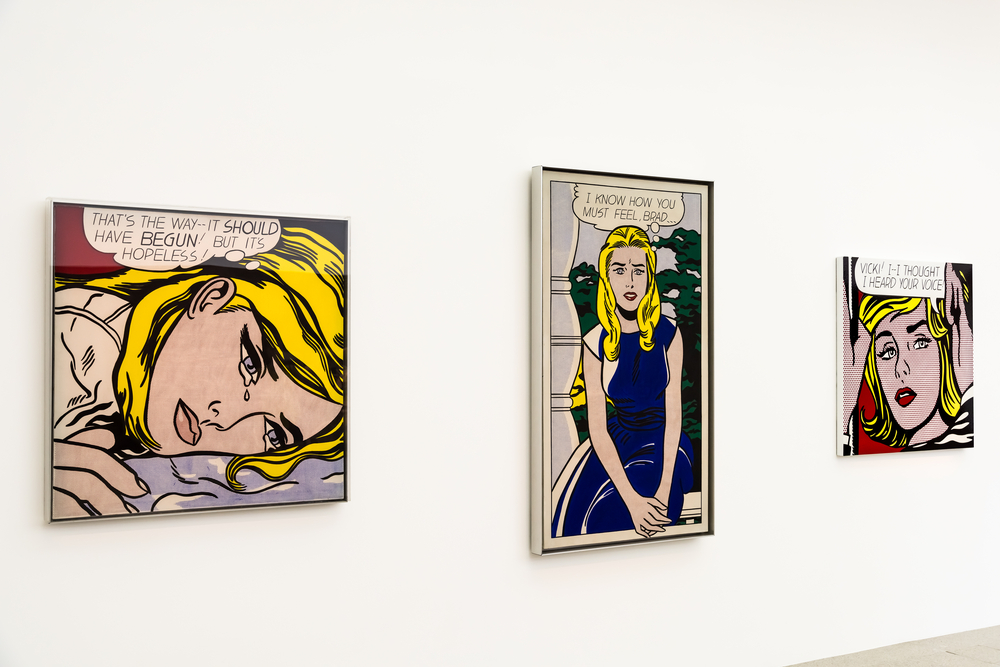
Warhol was suprised by what he saw. ‘I have things…that look very much like this,’ he said.
His encounter with Lichtenstein wasn’t simply about being beaten to comic imagery; it was about realizing that the gates had already opened. Pop art had already begun. Warhol was now looking for something original to do with his pop paintings. The advice he got from a friend was to find something everybody recognizes, something you see every day. The friend suggested he do paintings of Campell soup cans. The next day, Warhol and his mother bought every variety available at the local supermarket.
The cans were painted laboriously and their labels stenciled. The paintings looked like merchandise, but they were stubbornly handmade. Warhol cut the stencils to get the lettering right and mixed paints to capture the speckle of tin. His canvases were not identical to the cans they depicted. They bore the marks of the hand, the imperfections of his process. If he had wanted to really replicate them, he could have done it.
Irving Blum offered Warhol his first solo show at the Ferus Gallery in Los Angeles. Warhol shipped 32 paintings to Los Angeles, each featuring a different type of Campbell’s Soup.
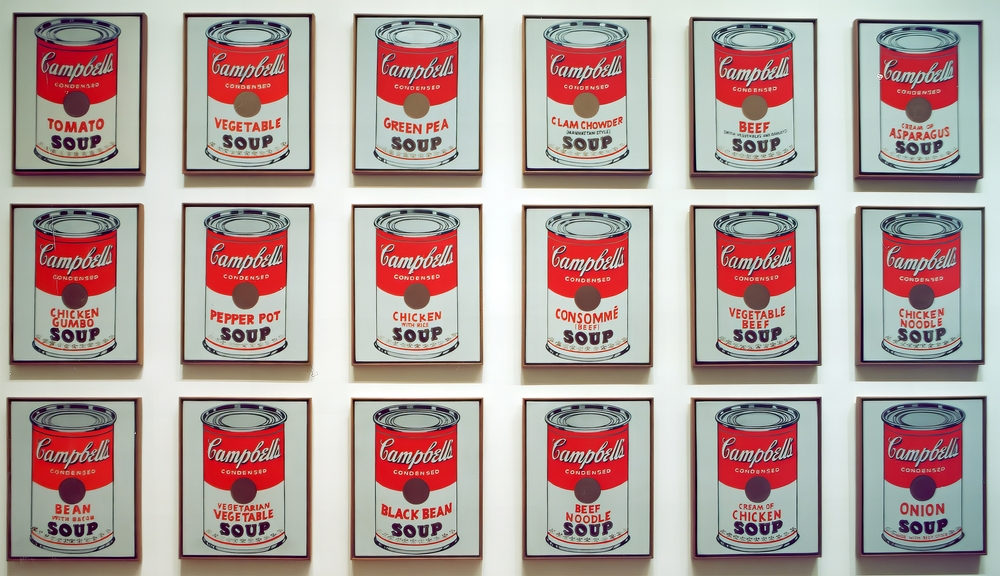
Warhol himself did not attend the opening, and the exhibition proceeded without a formal reception. Rival galleries mocked the show, stacking real soup cans in their windows with signs urging customers to ‘get the original.’ Although the show is now seen as a landmark in the emergence of pop art, it initially attracted little attention.
Warhol was looking for a bigger studio as he became more successful. He found a raw, industrial loft on East Forty-Seventh Street. When he moved in, the space was grimy and decaying. The furniture was scavenged and mismatched. A battered red sofa was salvaged from the street. His assistant Billy Name began silvering everything in the studio—walls, pipes, even the bathroom stalls. Roll after roll of aluminum foil was stapled, smoothed, and stretched across every available surface. He transformed the studio by covering the walls in tin foil and silver paint, turning it into a kind of low-budget spaceship.
Over time, the silver spread to everything: Warhol’s stereo, furniture, windows. The foil erased daylight by covering up the windows, and the last trace of the outside world was sealed off, replaced by a continuous, artificial glow. Name filled the studio with theatrical spotlights so that it was permanently lit. The aluminum-foil walls reflected light in a way that made everything feel slightly unreal. Warhol called his new studio the Factory.
For his next project he produced four hundred faux grocery boxes—Brillo pads, Heinz ketchup, Kellogg’s Corn Flakes—the wooden replicas stacked like warehouse inventory.
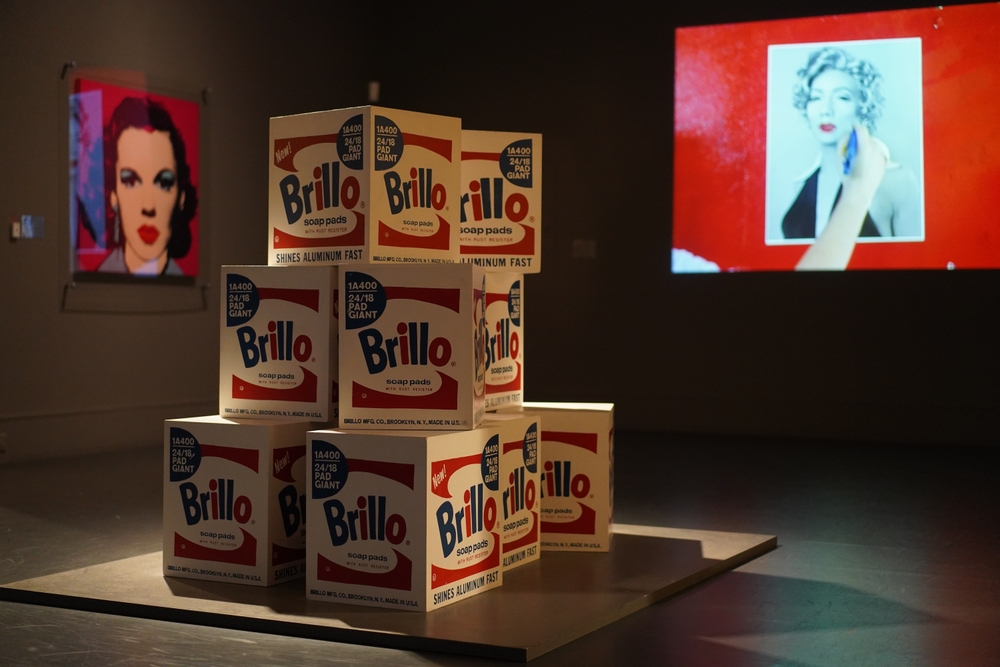
When the boxes failed to sell, they were simply wrapped in plastic and stored away, like surplus inventory.
Gerard Malanga entered the scene, bringing with him skills from graphic design and advertising. He began working with Warhol as a studio assistant, helping him make his silk screens. Warhol selected images from magazines or photographs, outlined them on tracing paper, filled them with Liquitex paint, and pushed acrylic through silk screens with a squeegee. The process was fast—two hours per canvas—and mechanized. Warhol was a brilliant colorist, transforming Elvis, Marilyn, soup cans, and electric chairs into stark emblems of a machine age.
For his Marlyn Monroe paintings he used photographic silkscreen printing, reducing her face to a ‘vacant façade’ and treating her image like a commercial product. He noted that the repetition of her face emptied it of meaning.
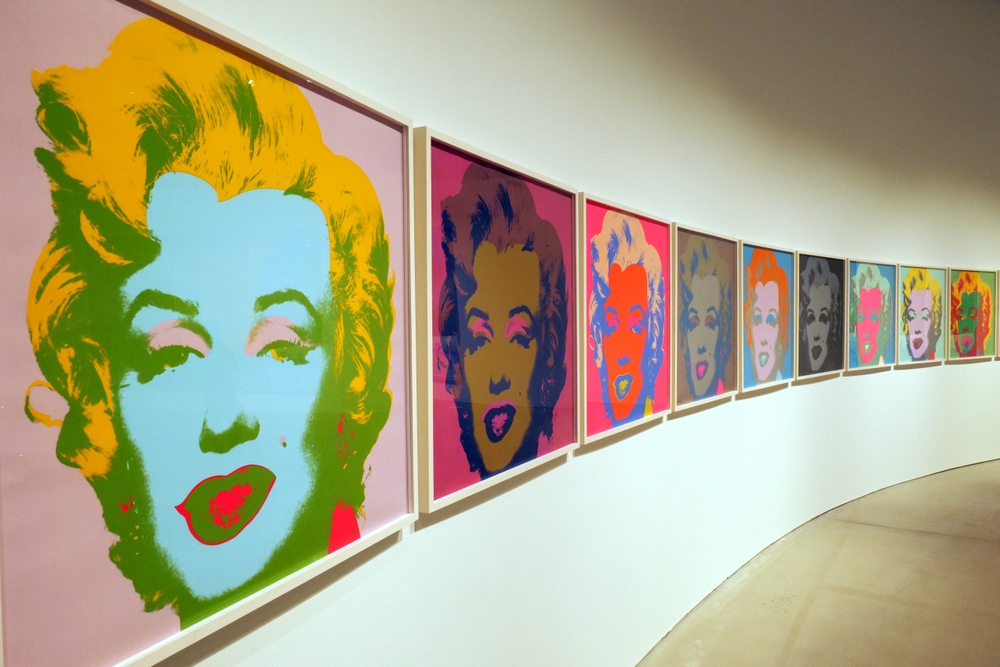
In his repetition of images, in the mechanical reproduction of faces and products, he suggested a world flattening into monotony. Warhol understood that America was becoming a place where everybody consumed the same images in endless loops. He saw celebrity evolving into something hollow and reproducible. He detected a spreading sameness.
‘Everybody looks alike and acts alike, and we’re getting more and more that way,’ he said. ‘I think everybody should be a machine.’
In Warhol’s vision, the machine age had already consumed the human one. He saw a society riddled with alienation, repetition, and emotional numbness.
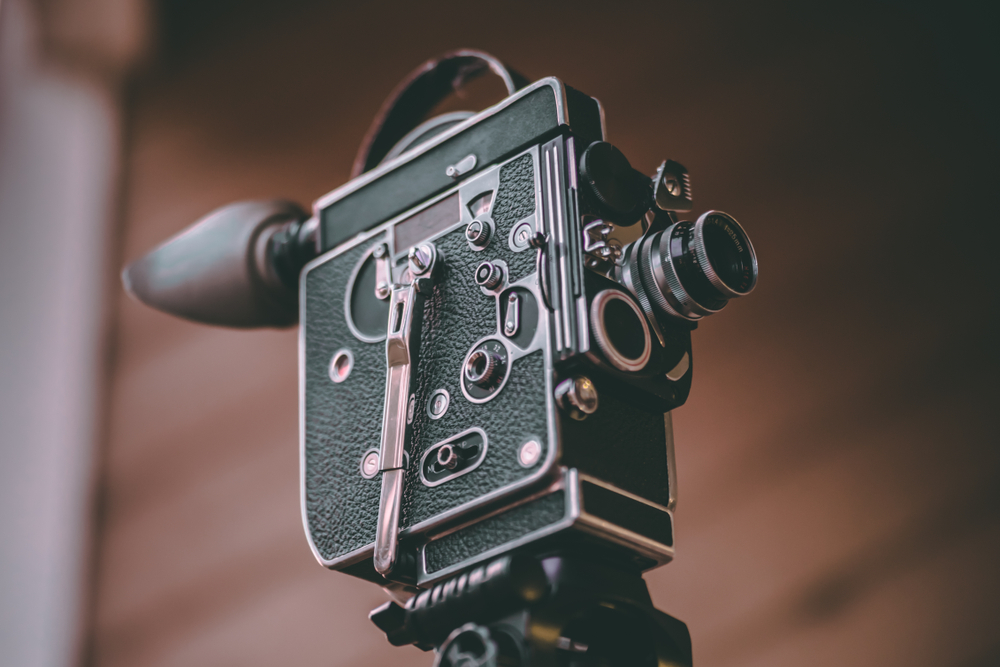
Warhol then got interested in film. He picked up a Bolex camera and began to document the world around him, wanting to capture life as it unfolded in real time. The Factory would become his new film studio, its aluminum-foil walls reflecting everything back in a distorted shimmer. Film canisters lay scattered across the floor and a silk-screened canvas of Elizabeth Taylor hung on the wall.
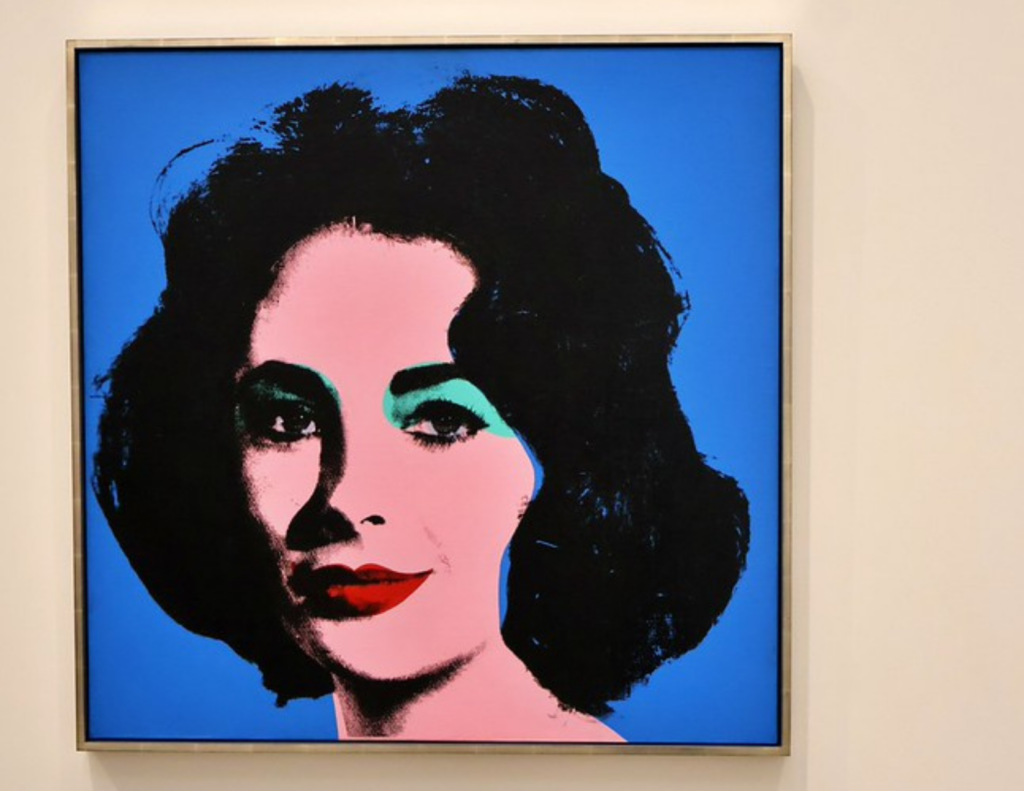
Warhol saw a society increasingly defined by surfaces. He grasped how hollow and alienating American life was becoming. His work, his films, his social life all reflected a culture obsessed with stimulation and repetition.
Warhol was awkward, nearsighted, and deeply insecure about his looks. He soon realized that stunning, socially powerful women could act as his passport into a world of wealth and influence. So he began to collect them. He called them his superstars. These were people whose personalities were as compelling as any painting or film. They were fiercely independent, and at the same time, profoundly self-destructive. They were muses, collaborators, and, at times, carefully curated accessories. In Warhol’s Muses, Laurence Leamer portrays them as both the driving force behind Warhol’s creative world and some of its most tragic casualties.
The first superstar he discovered was Jane Holzer, the daughter of a Palm Beach real estate magnate. She came from a world of quiet wealth and lived in a luxury apartment on Park Avenue with her husband. The apartment with its old master paintings and imposing furniture, felt like a relic of another era. Her husband, Leonard Holzer, preferred the predictable rhythms of home, but she was bored of the sedate rituals of Park Avenue.
One afternoon, Holzer was walking with the photographer David Bailey on Madison Avenue when they spotted Warhol across the street. Bailey waved him over, and Warhol came up to talk to them. He asked Holzer if she wanted to be in the movies.
‘Sure,’ she said. ‘Anything’s better than being a Park Avenue housewife.’
Holzer was someone who could bring him into elite social circles. She, in turn, saw Warhol as a gateway to a different kind of fame, one that was edgier, more avant-garde, less constrained by traditional expectations. Together, they made a plan that would benefit them both. Warhol would cast her in his films, elevating her visibility within the downtown art scene. He would accompany her to parties and dinners, lending her an aura of experimental cool.
Warhol saw in her a ready-made star, and she arrived at the Factory as if she had been pre-cast. She appeared in his silent screen tests where she was filmed chewing gum with a toothbrush in her mouth. Warhol filmed her glamour with the same blank curiosity he brought to his other projects. He filmed her kissing and arguing in borrowed apartments. He filmed her and other Factory regulars drifting through the apartments that grew grander by the week, apartments lent to him by his wealthy friends.
He filmed Holzer often on the Factory’s couch, a discarded Art Deco sofa upholstered in crimson velvet. The couch, taken from the sidewalk like a found relic, became more than furniture. It was a stage, a gathering point. People sat on it, sprawled across it, performed on it.
His film Couch turned social life into an unedited confession booth. It documented a changing cast of Factory regulars and visitors—Malanga, Name, and a rotating ensemble that included Allen Ginsberg and Jack Kerouac. When Warhol asked Holzer to kiss her friend Nicky Haslam, she didn’t hesitate. The kisses lingered past comfort, past romance, into something faintly mechanical. Kissing, conversation, and more explicit acts unfolded. The most controversial footage included an interracial ménage à trois.
Leamer wrote: ‘The scene was typical Warhol, as erotic as milking a cow.’
For Holzer the Factory was a world far removed from the controlled elegance of her upbringing. While she enjoyed Warhol’s company, many of the people who surrounded him made her uneasy. Warhol began taking her to parties and gallery openings. Holzer moved fluidly between exclusive parties and seedier art-world hangouts. She was a society beauty slumming downtown, a debutante wandering through the avant-garde. She was Warhol’s ‘Girl of the Year’ for 1964 and now was being written up in the glossy pages of society magazines.
She appeared on the cover of British Vogue, confirming her arrival as an international style figure. Weeks later, she was in Paris, seated front row at a couture show. Her wardrobe shifted too, away from the elegance of a society wife toward something more deliberately undone, like black jeans and sweaters. She was a surface onto which others could project meaning. Her celebrity existed largely because magazines, photographers, and columnists found her fascinating. Critics questioned her substance, noting that her talents seemed limited to kissing, dancing and posing.
Warhol saw how the modern world was increasingly replacing direct experience with representations of experience. He saw how television flattened these experiences into a seamless flow of images
‘When I got my first television set,’ he said, ‘I stopped caring so much about having close relationships.’
Warhol kept ‘multiple sets on at home’, glancing back and forth between screens the way a trader scans markets. He dabbled in making TV commercials. One of his early ads for a restaurant chain proved unexpectedly successful. It was blurry and oddly composed, designed to resemble the fuzzy picture of a badly tuned television set.
‘You know, I’m really in love with TV commercials,’ he said. ‘I think they’re among the best things on TV, and they should run much longer than they do.’
That insight became Soap Opera, a film that spliced real television ads—shampoos, miracle knives, toaster ovens—into scenes that seemed deliberately dull and disconnected. Warhol blasted the commercials at full volume while making the dramatic scenes completely silent. He maintained the same ratio of ads to ‘story’ as found in actual daytime TV. Filmed over many months and spanning forty reels, it became his most extensive project to date
One of Warhol’s earliest ventures into filmmaking was called Sleep. Coming home one night, he saw his lover John Giorno sleeping in bed. He was intrigued so he set up his equipment and began filming. Warhol, wired and wakeful, filmed Giorno for hours as he slept, night after night, until the footage accumulated into a five hour film. He slowed the projection to stretch time itself, manipulating the projection speed using a switch on the Bolex camera, showing twenty-two views of a body at rest: from the feet, from the side, over the headboard.
Watching Sleep, Gopnik suggests, is like experiencing ‘a night of perfect, unbroken sleep.’ You can feel the monotony, the lulling repetition, the strange beauty of it all. Nothing happens, and yet the viewer becomes aware of everything—the rise and fall of breath, the shifting of light, the passage of time.
One day, Warhol was having lunch at the Russian Tea Room with the director Emile de Antonio. De Antonio, who often boasted about his drinking made a reckless offer, a macho dare: he would drink a quart of whiskey in twenty minutes on camera. Instead of urging restraint, Warhol encouraged him to drink the dangerous amount of scotch, and the camera would record the result.
The setting for this act of self-destruction was a cold, unheated stairwell in the Factory. Warhol positioned himself above, camera and floodlights angled downward. The camera rolled for sixty-seven minutes as de Antonio drank whisky. At first, there was control—measured sips, coherent speech, a man aware of being watched. He was composed, even charming. As he drank, his demeanor shifted. He began to sing, then rant. At one point, he could no longer stand.
He staggered, slurred, eventually collapsed, crawling on the floor, and then he pounded his head against the wall. The result was an unblinking record of a man drinking himself into collapse. There was something unsettling about watching a mind deteriorate in real time. Warhol watched it without intervening. For him, this was material, an unfiltered glimpse into human behavior pushed to its limits. At the end of the film assistants hoisted de Antonio’s limp body from the stairwell, carrying him to the Factory sofa. Nowhere was Warhol’s detachment more evident than in that film. His curator was quite shocked.
‘This is really one of the most reduced images of a human being I’ve ever seen,’ she said.
The one-person film was titled Drunk and was one of Warhol’s many films in which personal breakdown was routinely captured, shared, and consumed.
His next film was Empire, an eight-hour, single-shot portrait of the Empire State Building that transformed a familiar New York landmark into a meditative study of time, stillness, and observation.

Warhol filmed it as daylight drained away and the building’s lights came on. The slightest change—a flicker of light, the deepening of dusk—became monumental because there was nothing else to hold onto.
‘When the lights on the building were turned on,’ said a viewer, ‘it seemed as though the world had been recreated.’
The censors tasked with reviewing Empire were so exhausted by the ordeal that they began rotating shifts, ultimately deciding that no future underground film could possibly demand such work again. At the film’s premier, the audience had to sit through nothing happening. People walked out. Many went to the box office and demanded their money back.
Warhol tested the limits of stillness with Sleep and Empire. He compared his movies to porch-sitting and fireplaces, things you keep on in the background while you eat, read or sleep. The films taught Warhol how to let time be the subject. These films were rarely shown outside the confines of the Factory or select avant-garde venues. Collaborators remembered Warhol studying his own films with the concentration of a playwright on opening night. He could sit through them with rapt devotion. He found meaning in the act of looking when almost nothing happens. The less that happens on screen, the more the slightest shift becomes an event.
Warhol worked long hours at the Factory, fielding phone calls deep into the night. The only drug he took was Adderall. He took enough of it, he said, to sleep only two or three hours a night. He took the pills daily, fueling a relentless pace of work. In the 1960s, this was not unusual. Speed was everywhere: prescribed by doctors, sold on the street, swallowed by students, socialites, politicians, and celebrities. Americans consumed billions of pills annually.
By the mid-1960s, Warhol had turned his Factory into a kind of experimental theater, a space that was part studio, part salon, and part nightclub. The Factory was a place where everyone auditioned without knowing for what. There was a rotating cast of poets, hustlers, heiresses, filmmakers and drag queens.

You had to be strange enough to be interesting. At the Factory, everything was material: faces, conversations, accidents, boredom. It was a creative underworld where people willfully descended into a realm of altered time and creative activity. One moment, someone might be shooting a film; the next, another artist would be staging a performance or reading poetry.
The Factory was not an easy place to inhabit. Between the silver walls lurked the Mole People, amphetamine addicts and drifters, moving through the space like rare nocturnal animals. They slept rarely and spoke with manic intensity. They dressed in black and wore sunglasses indoors, their altered states requiring a kind of self-imposed twilight. Their skin was pale from living mostly at night. They appeared in Warhol’s Screen Tests and more experimental films.
Ondine, their volatile leader, became a star in Warhol’s films after meeting him at an orgy where Warhol, characteristically, had stood back to observe. Ondine, known as the ‘first great Mole Person,’ had emerged from the beatnik underworld. He was a nocturnal creature with pale skin who wore leather pants and black turtlenecks. Ondine understood that fame itself was theater. With his biting humor and erratic energy, he became one of the Factory’s most compelling figures.
Paul Morrisey was a film director who met Warhol in 1965. He had opened the Exit Gallery, a modest cinema on East 4th Street that served as a kind of incubator for underground film culture where he screened documentaries and experimental work. He claimed to disdain the avant-garde even as he curated it, distrusting movements and manifestos. What interested him were people, specifically, the strange, luminous, damaged personalities that hung around the Factory.
He became a collaborator with Warhol, making projects, guiding careers, and doing much of the thinking that Warhol preferred to avoid. Warhol had a near-total disinterest in directing, often turning on the camera and leaving the room. If Warhol provided the blank canvas, Morrissey introduced the faint outlines of narrative, the suggestion that these drifting lives might cohere into something like a story. He thought of things Warhol might do, did them, and then pretended Warhol had done them himself.
Warhol seemed not to be in the room, even when he was the one quietly shooting everything that happened in it. He hid behind a camera, behind Polaroids, behind assistants and screens. He pretended to be barely there. He was a voyeur-sadist.
Leamer wrote: ‘He let into his presence all sorts of broken people who sought fulfillment in the Factory. As he stood back watching, often with his sunglasses on, they performed for him in explicit and inexplicit ways.’
Among the more curious figures at the studio was Billy Name, who seemed to exist on the edge of the scene. He was a Mole Person who became disheveled and erratic from taking too much speed. At the Factory he became a kind of spectral caretaker.
Morrisey said, ‘He lived in a toilet for four years, a black-painted toilet with no real light inside. He sat in there reading mystical texts and the cabala, things like that.’
His days and nights inverted, he operated on a schedule entirely out of sync with the outside world.
‘He’d been in the toilet for so long,’ said Morrissey.’ He’d only come out very late at night so nobody would see him.’
He lived in near-total darkness and his body began to deteriorate from the lack of light. He emerged from that strange exile physically fragile and spiritually intense. When he resurfaced, he brought with him a strange visionary energy.
Warhol’s superstars appeared in his films, drifted through his parties, and trailed him across Manhattan. The allure of his first superstar, Jane Holzer, had begun to fade, and her presence was no longer enough. The electricity that had once followed her into rooms had started to wane. Warhol needed a new superstar. The city offered an endless audition. Warhol went out every night, drifting through rooms filled with extraordinary people, scouting for his next superstar. He was politely vacant, floating through parties shooting Polaroids instead of speaking.
Edie Sedgwick would be his next great discovery.
The meeting happened in early 1965 at a party thrown by Lester Persky. His gatherings were the kind of Manhattan parties where artists, advertisers, and socialites met. Edie arrived wearing a beehive hairstyle and a leopard-print outfit. As the music played she did one of her improvised dances, which was part rock-and-roll, part ballet. Her long earrings caught the light with every movement. People looked on as she danced. Among them stood Andy Warhol, hovering at the edges, watching. His supposed shyness was partly real, partly strategic. He observed everything, treating the scene as raw material.
When Edie met Warhol the connection was immediate. He saw her as a new kind of superstar and understood that her appeal lay not just in her beauty but in her volatility. Her presence was kinetic. He recognized her as both a muse and a commodity.
The next day he invited her downtown to his studio.
When Edie arrived at the Factory he made her do a screen test. These were silent three minute films in which subjects were instructed to sit still and stare into the camera. Warhol called them tests to imply an audition. Screen tests were essentially cinematic headshots that slowly revealed a subject’s personality.
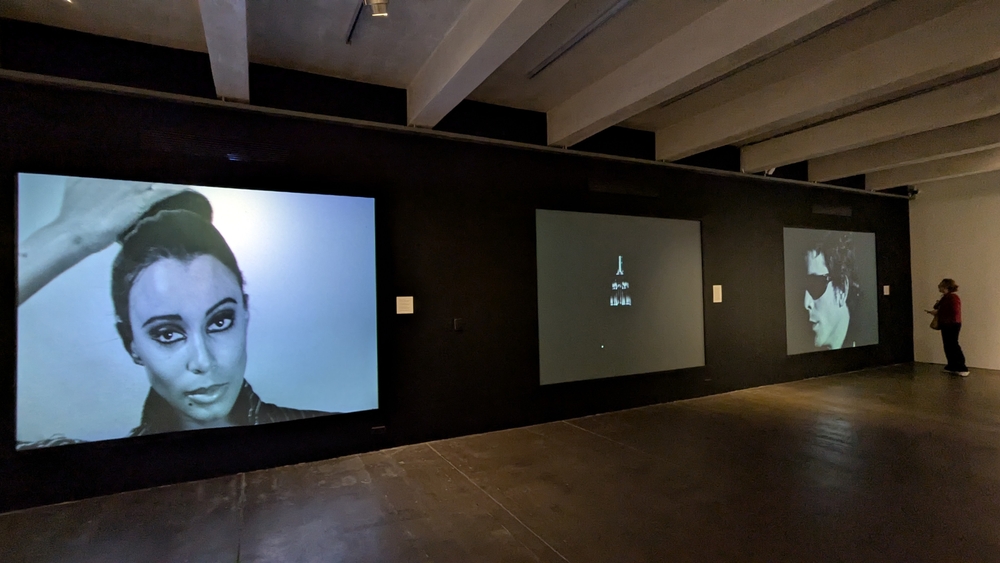
Warhol loaded his Bolex with three minutes of black-and-white film, seated Edie under the lights, and walked away. He never looked through the lens; he let the machine watch for him. Edie sat alone with the gaze of the lens and tried to hold a face, to maintain a pose.
A week later, when she came back to the Factory Warhol was filming Vinyl, loosely inspired by A Clockwork Orange. Malaga played a juvenile delinquent whose main function was to be brutalized, drugged, and disciplined by shadowy agents of authority. It was an all-male sadomasochistic fantasy, until Warhol made a last-minute decision. Edie would be in it.
‘She won’t talk,’ he said. ‘She won’t get in the way. We’ll stick her in for decoration.’
He perched her on a trunk beside Malanga, her newly streaked bouffant catching the light. She was instructed simply to watch. She chain-smoked, looking as though she had strayed from ‘a ladies’ luncheon at the Metropolitan Club.’ She flicked ashes on a runaway Canadian boy who was being tortured. The film included straps and leather masks and ritualized cruelty. Onscreen, the men brutalized one another. As tortures unfolded, Edie seemed bored, nearly nodding off mid-depravity when a leather hood was put over Malanga’s head.
Warhol was now being recognized for his work. The filmmaker Jonas Mekas presented him with an independent film award for his groundbreaking, slow-paced films. He said, ‘It seems that perverts today have more creativity, more visions, more sensitivities . . . than the healthy artists.’
Warhol made films about hustlers and rent boys, about sex lived on the fringe. Most avant-garde filmmakers of the era favored jittery handheld cameras and rapid cuts. Warhol went the other way. He placed the camera in one spot and let it run, sometimes unattended.
Warhol positioned Edie as a silent observer amid chaotic Factory antics. He filmed her talking about herself. She spoke in restless, unfiltered monologues about her past. The films captured her otherworldly beauty. They weren’t traditional movies so much as moving portraits. He had experimented with various superstars, but none possessed Edie’s magnetism. He filmed her again, and again, always with the same cool remove. She always gave him something to look at. Watching her sleep, he was fascinated by the smallest shift of her body on a pillow. She was pale and luminous against stark white sheets. A three-minute shot of Edie sleeping became the prologue to a half hour of mirrors, makeup, and cigarettes.
For Warhol, she was the perfect subject. She embodied the intersections he found most compelling: wealth and instability, beauty and damage. Her beauty was matched by a fragility, a vulnerability, and an energy that he immediately recognized as perfect for the camera.
Warhol made Poor Little Rich Girl for her—sixty-six minutes of cinema vérité shot in her apartment. The film is meant to be a day in her life. It opens with her waking late, asking for five orange juices and three coffees over the phone. Warhol turns his camera on her in the slow, hazy hours of late afternoon. Due to a faulty camera lens, the first reel is entirely out of focus, rendering Edie as a soft blur drifting through her Upper East Side apartment. Her movements are ghostlike.
Edie strips down to bra and panties and drifts through rituals of getting ready. The camera lingers as she applies makeup. She can speak, move, dress, and undress as she pleases, yet she is always being watched. The viewer is caught between intimacy and intrusion. Edie moves with the languor of someone who has nowhere to be and nothing to prove. The only sounds are the steady rotation of an Everly Brothers record and the faint mechanical whir of Warhol’s camera. There is no dialogue, no explanation, no attempt to guide the viewer. This accidental blurriness becomes the film’s most haunting device as Edie’s face dissolves into shadow and her body merges with the walls.
When the film abruptly snaps into focus halfway through, it feels jarring. Clad in black underwear, Edie lounges on her bed, answering questions from a man whose voice drifts in from off-camera. She is filmed talking on the phone, walking back to bed, then rifling through her closet. At one point, she slips into a leopard-skin coat, prompting the man off camera to dismiss it as ugly. Words come from off-camera, sometimes with little relation to what Edie is doing.
Warhol remained silent throughout. His presence was felt only through the camera, which observed without judgment or intervention. He watched from behind his sunglasses as she performed for him. He commented on her ability to improvise.
‘To play the poor little rich girl in the movie, Edie didn’t need a script,’ he said, ‘if she’d needed a script, she wouldn’t have been right for the part.’
Plot meant nothing to Warhol.
‘Scripts bore me,’ he said. ‘It’s much more exciting not to know what’s going to happen.’
Poor Little Rich Girl was improvised cinema. For most viewers, it was nearly unwatchable, a chaotic collection of gestures masquerading as a film. Jonas Mekas hailed the film as a pinnacle of cinéma vérité, calling it beautiful, sad, and profoundly revealing.
Warhol always maintained an air of detached boredom. In interviews, he gave answers that revealed nothing while suggesting everything. When interviewed about his films he often responded to questions with single words. Asked if his movies carried a deeper message, he paused behind his tinted glasses and said simply: ‘No.’
Together, Warhol and Edie became New York’s most photogenic couple. They moved through a nightly circuit of parties, from Greenwich Village lofts to Park Avenue galas. They even dressed alike, both wearing striped sailor shirts. Edie’s silver-streaked hair and fragile frame made her look like Warhol’s female double. Their movement from party to party became a public performance. At the opening of an art show at the Metropolitan Museum, cameras pivoted away from Lady Bird Johnson to catch Edie in pink pajamas over a body stocking, her hair cut short and dyed silver to match her companion’s. At the opening she responded with practiced ease to Warhol’s direction. He guided her subtly, whispering cues.
Edie moved through the night with the confidence of someone who had always been watched. Her life unfolded in public, in the endless circuit of parties, clubs, and art openings.
Warhol said, ‘There was never a minute around the clock where you couldn’t be at some kind of a party. It’s amazing how little you want to sleep when there’s something to do.’
Even at the best parties, Edie always wanted to leave. Not because she was bored, but because she was permanently drawn toward the possibility of something else happening somewhere else.
They moved through the city like characters in a film that never stopped shooting. Warhol, who had long felt himself to be invisible, suddenly became impossible to ignore. He knew that attaching himself to a luminous figure like Edie amplified his own visibility. She was a kind of public ‘girlfriend.’ Now he mingled with socialites like Isabel Eberstadt. Before Edie, Warhol hovered at the edge of high society. After Edie, he was suddenly appearing at parties he had never attended before.
Back at the Factory the work continued. The studio became a production line and the art was made in batches. Forty-six Elvises, guns drawn, lined the walls like a firing squad of sameness, the silver ground beneath him shimmering like a movie screen. The source image was a publicity still from Flaming Star, a B-grade Western that reduced Elvis Presley to a cardboard avatar.
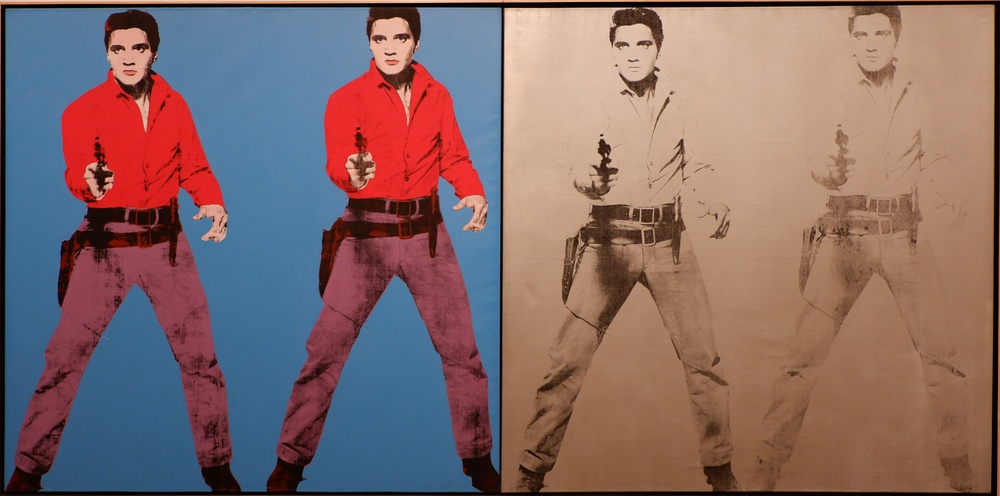
Hollywood, Warhol insisted by repetition, was an industry no different from soup the way it manufactured products for consumption. He was taken in by the visual, and as part of his vapid image he claimed not to be interested in books.
‘I never read. I just look at pictures,’ he said.
Warhol liked boring things. He had a way of making the boring feel deliberate, and learned to look at the ordinary until it became interesting. He believed art should become increasingly empty, stripped of emotion and intention. He was devoted to surfaces. Depth bored him.
Eberstadt said, ‘There may not be another person who has felt and thought as deeply as Andy.’
Warhol went on to create one the most disturbing bodies of work in twentieth-century art: the Death and Disaster series. The paintings were about the uniquely American relationship to violence. Modern life trains people to consume catastrophe the same way they consume soup, cigarettes, movie stars, and television commercials. Warhol took his images from newspapers, police archives, tabloids, and wire-service photographs. The Death and Disaster series were paintings of car crashes, electric chairs, and tabloid tragedies. A photograph of an electric chair, used in the execution of Julius and Ethel Rosenberg, was transformed into a series of haunting, almost abstract images.
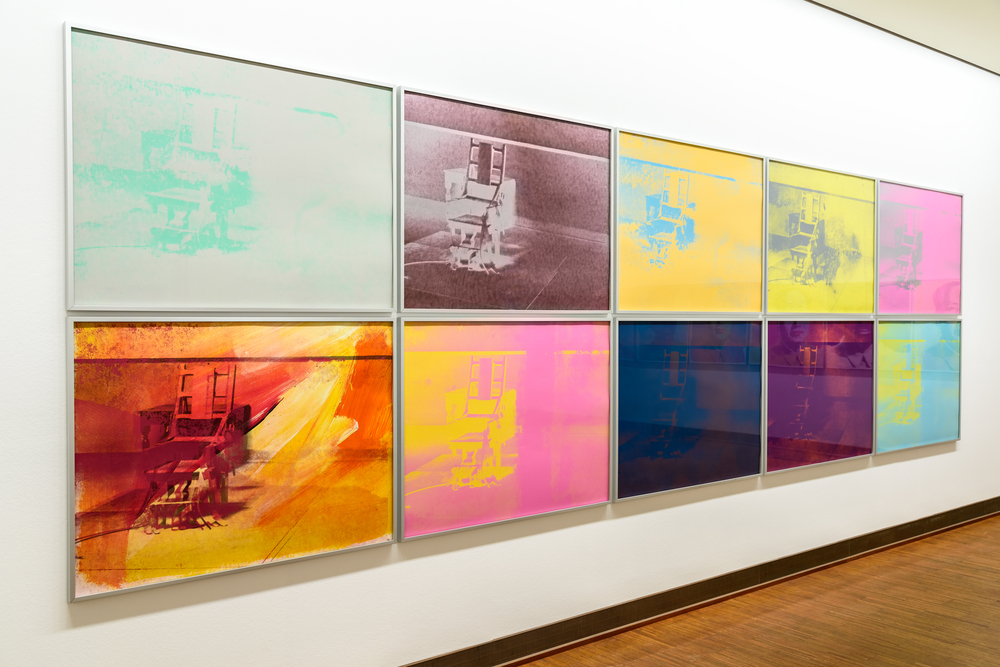
Warhol silkscreened the mangled automobiles and anonymous corpses reproduced endlessly in mass media. A single image of death shocks the viewer. Nineteen identical images begin to feel abstract.
Warhol said, ‘When you see a gruesome picture over and over again, it really doesn’t have any effect.’
A newspaper headline and photo of a plane crash became an eight-foot painting. The horror was not amplified but distanced, made with the same dispassion as a soup label. Warhol’s work did not ask viewers to feel; it asked them to notice how little they felt. Warhol took on the burden of this bleakness.
Eberstadt said, ‘He’s in the coldest, loneliest position because he’s decided to accept all the guilt and horror.’
Warhol was fascinated by Edie and her haunted glamour. He studied the way she dressed, the way she moved, the way she applied her makeup. Her makeup ritual could stretch for hours and the result was astonishing: a face that could endure twelve hours of parties without a single flaw. She was a person who seemed to exist solely to be looked at. Warhol treated her appearance and persona as a living performance, shaping every detail from her makeup to her wardrobe. He filmed her having her hair cut. The bouffant hair gave way to a stark pixie cut and her couture wardrobe changed into a uniform of tights and simple tops.
He loved her differently than he had loved any woman. He even mimicked aspects of her style, reinforcing the symbiosis between artist and muse. He watched the way she walked, how she moved through spaces with an innate sense of belonging. Edie was never still. She was not someone you could leave alone with a book or a quiet thought.
Warhol and Edie went out a lot together. They dined at upscale restaurants, often surrounded by a crowd, with Edie casually picking up the check. Warhol often accompanied her on nightly rounds of parties. He understood that Edie’s greatest talent was simply being herself, so he filmed her constantly, capturing vignettes of her daily life. The camera lingered on her expressions, her restless gestures, the flicker of emotion across her face.
Warhol wanted to film an entire day in her life without editing, without rehearsal. He was interested in the slightest motions—a glance, a shift in posture, the way she held a cigarette. The greatest stars, he believed, were those who could hold attention even in stillness, who could make the smallest gesture feel significant. Edie was willing to expose herself on film for attention. The camera lingered as she moved from nightgown to underwear. She stripped, smoked pot, and responded to off-camera prompts. When she wore black lingerie paired with white stockings, her look carried echoes of Berlin cabaret.
Warhol and Edie grew increasingly close over time. She spent more time with him than anyone else and appeared in every sound film he produced during that stretch. Beautiful, fragile, and endlessly photographed, she was Warhol’s ‘Girl of the Year’ for 1965
The Factory specialized in damaged beauty. Warhol understood that damaged people often made the most compelling stars. The silvered walls and tinfoil surfaces of the studio created an otherworldly sheen. During the day it was an art studio. At night, the Mole People took over. They had a sleepless devotion to sensation and the Factory was their nocturnal enclave.
They were hollow-cheeked men in black turtlenecks and women with raccoon eyeliner. There was the Duchess, Mr. Clean, and the Sugar Plum Fairy. There was Rotten Rita, whose nickname sounded like a downtown comic-strip villain. She earned her nickname through a combination of neglect and attitude. Billy Name was another mole. He became the night watchman at the Factory, and slept there, in a closet converted into a darkroom. He emerged mostly at night, leaving behind only empty takeout containers as evidence of his existence.
Cameras rolled constantly at the studio and the actors relied on stimulants to keep going. The silver décor amplified the sensation of being on speed. The drug flattened hunger, erased sleep, intensified performance, and made it possible to remain permanently ‘on’ inside Warhol’s endless happening. Ondine drifted through the background in sunglasses, talking in ecstatic monologues. He hadn’t slept in three days and believed this to be a spiritual advantage. He spoke in torrents. Friends recalled him carrying on conversations for twelve straight hours.
The Mole People also reflected a deeper New York mythology: the city as glamorous ruin. Mid-century Manhattan still contained abandoned industrial spaces, cheap rents, and enough urban anonymity to allow entire subcultures to flourish unseen. The moles were one of these subcultures. They lived underground. Their clothes were often scavenged. They moved through Manhattan with eerie confidence, as if they alone understood the city’s real frequency.
They were invisible people, hustlers and subway prophets, creatives and queer outsiders, speaking in rapid-fire bursts about art and literature. In another age they might have been occultists, silent-film stars, or patients confined to a Viennese sanatorium. Mary Woronov was close to them. She was a Warhol superstar, ‘the butch one,’ the strong girl at the Factory. She recalled that Warhol was a vacuum, his nondirection created a void performers filled with ‘the most uncalled for and amazing shit.’ In that void, people escalated. They became louder, stranger, and more extreme.
Woronov partied a lot with the Mole People. They were known for their amphetamine binges and nervous breakdowns as they wandered through the silver rooms of the Factory.
Leamer wrote: ‘As Woronov took more and more amphetamine, she became one of the moles. It was a swift descent into a dark, insular world.’
Warhols first solo museum exhibition was held at the Institute of Contemporary Art, Philadelphia. The art opening was an event. Floors were painted silver, music blared, and the atmosphere mimicked the chaotic energy of Warhol’s studio. A mobile disco blasted rock and roll, transforming the space into something closer to a happening than a traditional exhibition. By the time the doors closed, thousands had packed into a venue meant for a few hundred. It was less a gathering than a crush with all the bodies pressed together.
The crowd had come not for the art, but for the personalities. The paintings were removed from the walls because they were being crushed by the crowd. It was an art opening with no art. When Warhol arrived, wearing sleek black and sunglasses, the room surged toward him. He and his entourage were swallowed by the crowd. Police formed a cordon as they climbed a wrought-iron staircase and got trapped on the landing.
Edie leaned over the railing, provoking the crowd into a frenzy. They shouted ‘Edie and Andy!’ From the staircase, she dipped toward them, extending herself like an offering. Hands reached up to touch her. Warhol was stranded there while fans shouted for his clothes. ‘We want Andy!’ they chanted. ‘Get his clothing!’ Warhol leaned over and gave his oversized, goggle-like sunglasses to an admirer. Photographs from the night showed a crowd of faces gazing upward, shouting for autographs and souvenirs, handing up merchandise for him to sign. They wanted talismans: autographs on commuter tickets, on soup cans, on any scrap of paper. He scrawled his signature on the items. Sometimes Edie signed his name for him.
Warhol and his entourage were rescued from the scene when firefighters arrived and pried open a trapdoor at the top of the staircase, ripping through the building with crowbars. The escape route led through dusty library stacks, down a fire escape, and finally into waiting police cars.
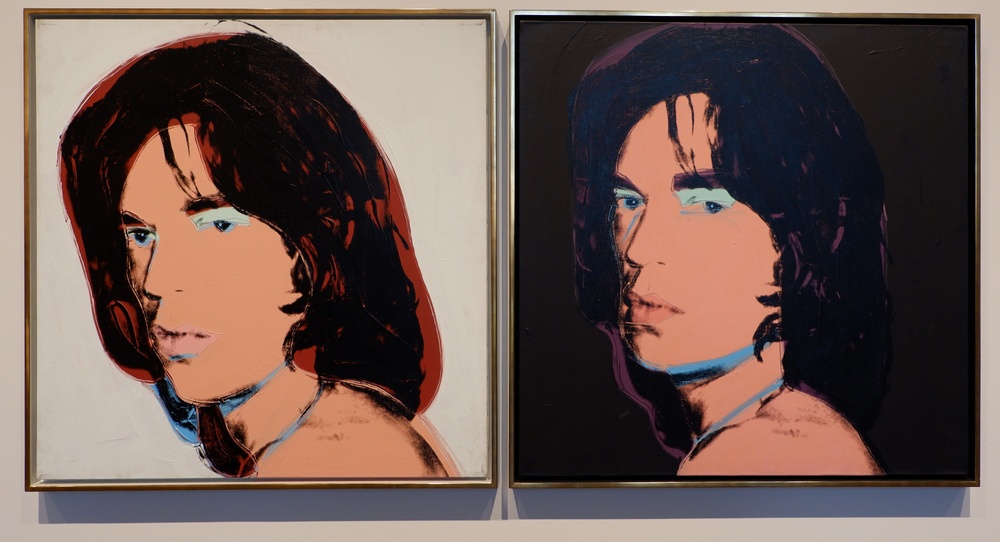
Warhol and Edie transformed celebrity from something distant and polished into something immersive and participatory. Columns tracked the pair’s movements and billed them as inseparable. They appeared on The Merv Griffin Show together. Photographers followed Edie when she went out, and headlines proclaimed her the newest superstar. She went out to clubs every night and was declared to have the best dancing legs since Betty Grable. When she met Mick Jagger at the Scene it caused a frenzied reaction from the press.
Warhol cast Edie in his new film Kitchen. The characters shared interchangeable names and drifted through dull conversations in scenes that unfolded in a cramped apartment kitchen. There was no relief, no visual escape, only the refrigerator, the table, the stove, and the actors. The room was less a domestic space than an operating theater in which Edie’s fragility could be clinically observed.
Actors wandered in and out of frame with the bewildered vacancy of people who had forgotten why they entered the room. Edie was told to drift in front of the camera and ’say whatever you want.’ The dialogue, when it could be understood, veered toward the banal and the surreal. Technical ‘flaws’ such as wavering lines and inaudible dialogue were not mistakes but features of the film.
In one scene Edie mounted a kitchen table, dressed in high heels, fishnets, and black panties. A man drifted in and out of the frame, talking to her, his conversation loose and unscripted. There were questions about misplaced underwear and a monologue about sex and degradation. Edie lay on her back on the table, doing bicycle exercises, her legs pumping.
In another scene a man washed dishes with his back turned to the audience. Edie rifled through trash, looking less like an actress than someone searching for misplaced medication. The man remarked that life was merely ‘one meaningless layer after another,’ A malted machine was turned on that drowned out the dialogue. Someone burnt a hand on the stove. Another man appeared in the kitchen to photograph Edie before disappearing again. Edie walked back to the table carrying her handbag and a makeup mirror, sat down and put on some lip stick. Then she was mock-strangled.
The film included sixty-seven minutes of makeup application, bicycle exercises on a kitchen table, and strangulation. Norman Mailer hailed it as perhaps the best film about the twentieth century, though ‘almost unendurable to watch.’
At the Factory everyone wanted to be noticed. People would submit to anything for the chance to be seen. The more outrageous you were, the more you mattered. For those already teetering on the edge, the constant pressure to perform—to be interesting, provocative, unforgettable—could prove devastating. Edie was one of them. She stood in for a generation that believed the camera might save them even as it took them apart.
For his next art project Warhol unveiled a series of paintings that looked, at first glance, almost absurdly gentle. Using an image of hibiscus flowers from a magazine, he produced hundreds of variations, transforming a simple photograph into a sprawling body of work.
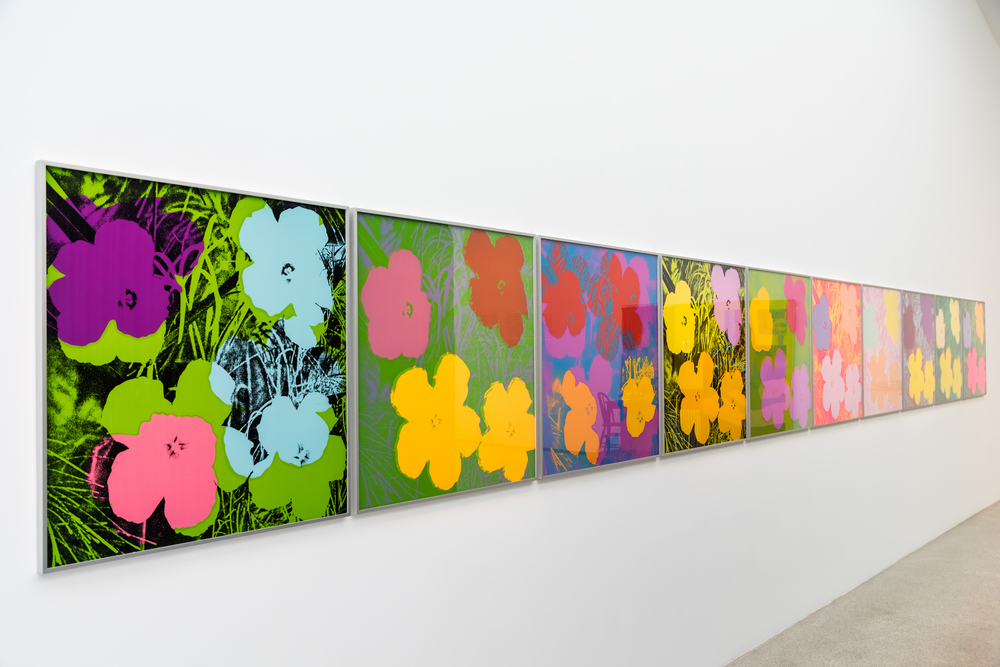
High art was not supposed to look this consumable. The paintings seemed too close to wallpaper, magazine layouts, or department-store displays. A Paris gallery prepared to open a show of the Flowers and invited Warhol to come there. His planned trip to Paris, tied to the exhibition, was transformed into a cultural event.
Before his departure, a farewell party was staged at the Factory, titled the ‘Fifty Most Beautiful People Party.’ The party was attended by poets, addicts, and socialites, the vaguely dangerous and the exquisitely bored. It was a swirl of underground celebrities and experimental music. Guests drifted through the silvered space, their reflections fractured by foil and broken mirrors. Malanga danced with Edie, whip in hand, his movements amplified by the shifting light. He carried a bullwhip everywhere. He was a dandy sadist whose performance blurred the line between menace and elegance.
In black tights and dangling earrings, Edie embodied the Factory’s volatile glamour. There was something unmistakably European in her allure, a hint of Berlin decadence filtered through an American lens. As she danced her chandelier earrings flashed under strobe lights. Silver balloons floated overhead. The party went on all night and everyone was having a good time. By dawn, the last guests drifted out.
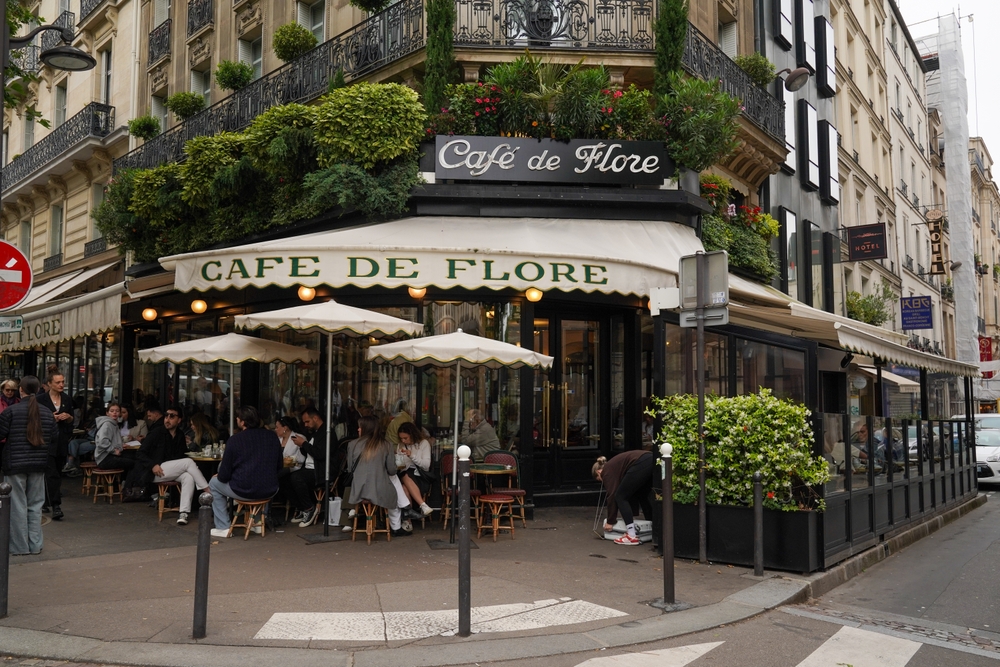
Paris, when it came, offered a different kind of stage. Warhol decided to bring his entourage, transforming the journey into a traveling spectacle. Edie came along with him. She arrived in Paris wearing a white mink over black tights. French photographers from Elle and Paris Match captured her in hotel rooms and on city streets, taking photos of her at café tables on the Left Bank and in filmy nightwear on fur-strewn hotel beds. Warhol and his crew appeared at cafés on the Left Bank and attracted admirers at Café de Flore, a hub of intellectual and artistic life.
At clubs like Castel, the group mingled with an international crowd. They met film stars like Catherine Deneuve and aristocrats like Prince Stash, an occult scholar who wore silk scarves and embroidered tunics and moved among artists, musicians and decadent nobility. He was captivated by Edie. He hypnotized her at a party, leaving Warhol both astonished and intrigued.
‘You have to come to New York and do it on film,’ he insisted.
In Paris, Edie dazzled strangers who had no idea who she was. When someone asked her how it felt to be a superstar, her answer was surprisingly candid: it was frightening, glamorous, and exciting all at once—and she wouldn’t change it for anything. Edie’s allure was inseparable from the artist who had sculpted her image. Warhol understood that attention itself could be art. Watching people become famous was as compelling as any painting. He saw precisely what was happening to celebrity as it morphed from achievement into performance art.
At the Factory he would set his Bolex camera rolling, then drift off to paint, letting the machine quietly record whatever unfolded in front of it.
His goal was to record reality with as little interference as possible, even if that meant subjecting audiences to hours of raw footage. He often filmed the furtive glamour of the Mole People. Chemically devoted to nights without sleep, they hung out at all-night diners and slept during the day. At the Factory, days blurred into nights into film shoots into arguments into ecstatic conversations no one would remember clearly afterward. The moles sat on the red couch, smoking and talking. Some arrived at midnight and stayed until dawn, the studio being their habitat. They were too strange to belong anywhere else.
They were brilliant and broken creatures who embodied the eerie devotion that Warhol inspired. He cultivated intensity in those around him and seemed to require a steady stream of exhibitionists. For them, getting close to Warhol’s glow promised transformation and exposure.
By the mid-1960s, Warhol had become the central enigma of his work. He was a pale, watchful presence who remained serenely detached, the ultimate observer who orchestrated everything. He was, as one participant put it, ‘the Big Director in the Sky.’ Paul Morrissey declared himself a follower.
Ondine commented on this. ‘Morrissey was the first person to say outright to Warhol: ‘I am your disciple.’ Nobody else involved with Warhol would think of saying it that way because Andy was the queen of passivity…the absolute son of non-existence. He was just divinely not there.’
The Factory was built on the premise that fame could be manufactured. The self was flattened into something reproducible. Superstars were elevated, celebrated, and eventually discarded as new fascinations emerged. Gopnik wrote that the superstars were interchangeable, branded products tumbling off an assembly line of attention.The superstars came and went like seasonal collections. Edie’s allure was now fading and Ingrid Superstar was being restyled to resemble her. She cut her hair short and mimicked her speech.
In the summer of 1965, Warhol and Edie stayed in a weathered shingle house on the beach in the Hamptons. The expansive ocean views and relaxed coastal setting offered a picturesque backdrop to one of the most celebrated periods of their friendship.

While sitting on the sand, looking out at the ocean Edie became philosophical and spoke about inner and outer universes. Warhol latched on to the conversation as an idea for a movie. In Outer and Inner Space, one of the first films to use video, Warhol shot her talking about her life and then filmed her watching herself on playback. The film doubled and tripled Edie until she became a chorus of selves, watching herself, reacting to herself, existing as both a subject and a spectator. Two reels ran side by side, four Edies sharing the frame.
Warhol framed her until she became strange to herself. She interacted with her own televised image, producing a hall-of-mirrors effect that captured her narcissism and fragmentation. In this doubling something essential is revealed. The Edie who exists as image, as projection, is not entirely the same as the Edie who watches and who reacts. For Edie, the experience was deeply unsettling. Confronted with her own image in real time, she recoiled, expressing discomfort with what she saw. In Warhol’s cinema, even discomfort was material, something to be captured and preserved.
Critic Amy Taubin later suggested Warhol was ‘shattering Edie’s fragile psyche’, using her ‘wounded narcissism’ against her.
An underground party at the Factory celebrated the film’s release. Guests entered to find Edie’s image already there, projected large against the walls in Outer and Inner Space, her face multiplied and ghosted in overlapping frames. A DJ behind the turntables blasted rock records. Malanga cracked a whip in rhythm with the music, sometimes joined by Edie, their shadows moving across the projected images behind them. Films flickered across walls while dancers whirled through strobe lights.
One day, Edie and Warhol had lunch at the Russian Tea Room, one of New York’s most fashionable gathering spots, where artists, celebrities, and socialites met for food and drinks.
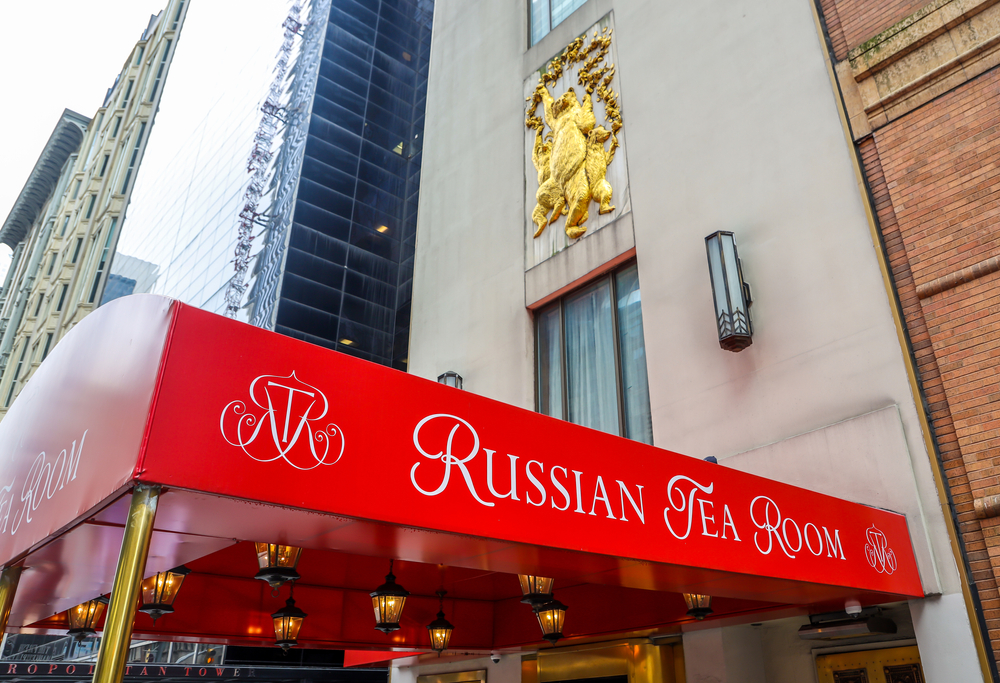
During the meal, Warhol proposed a retrospective of her films, suggesting that her work deserved renewed attention.
Edie was shocked. ‘Everybody in New York is laughing at me,’ she told him. ‘I’m too embarrassed to even leave my apartment. These movies are making a complete fool out of me! Everybody knows I just stand around in them doing nothing and you film it and what kind of talent is that?’
For months, her life had been mined for material. To her, the films were not art but exposure, evidence of a kind of emptiness she feared others could now see. Edie began to drift away from Warhol. She confided to a playwright that she could not get close to him. No one could.
Around this time, Warhol started bringing a cassette recorder to the Factory and began taping everything—phone calls, conversation, ambient noise. The recorder allowed him to transform lived experience into raw material without the messiness of emotional involvement. He no longer needed to participate in life; he could simply document it. The tape recorder was his confessional booth. Strangers revealed themselves, and every devastating revelation could be rewound and replayed. Soon a culture of mutual surveillance emerged, with others beginning to tape their own conversations. The tapes multiplied quickly, eventually numbering in the thousands.
The recordings allowed Warhol distance and control and gave him a way to sidestep the emotional demands of interaction. The tape recorder became an accessory as essential as sunglasses, a barrier that allowed him to remain both present and elsewhere. Conversations were transcribed almost exactly as spoken, with minimal editing and published as a sprawling experimental novel.
Warhol once said he wanted to be a machine. In many ways, he succeeded. Machines do not intervene. They record. They reproduce.
Warhol’s next discovery was the Velvet Underground. He first saw them at Café Bizarre in Greenwich Village where they played for nine dollars a night. The bar had sawdust on the floor and erotic murals on the wall. Skulls, shrunken heads, candelabras, and tribal masks decorated the brick walls. The Velvets played to a near-empty room six nights a week.
The night Warhol was there sailors threatened violence if the band continued playing. The band’s hostility to the audience, the menace, the feedback, the songs named for drugs and sadomasochistic fantasy, matched Warhol’s appetite for art that courted chaos and social dysfunction. The band trafficked in noise and nihilism, pushing their sound into more extreme territory. At one show, they unleashed a screeching wall of sound louder than most audiences had ever heard.
‘People would leave looking dazed and damaged,’ Warhol said.
The idea of a house band began to take shape as Warhol thought of adding rock to his art. He had already experimented with using rock music in his films, and the idea of collaborating with a band intrigued him. He envisioned the band performing alongside projected films. Lou Reed was the guitarist and singer of the band. He wrote songs about heroin, death, and the underside of urban life. The band blended well with Warhol’s films. He heard in their distortion the same kind of clarity he found in car crashes and electric chairs.
Reed wrote in the first person, slipping into characters with unsettling ease. He reflected on the violence embedded in American life, noting that his songs were less personal confession than character studies, influenced by films, stories, and the world around him. He supplied streetwise songwriting and lyrical menace. He also detailed his own mental health struggles. In conversations with friends, he spoke of shock treatments and sanity, mocking the idea of psychological ‘correction,’ of doctors prescribing pills to fix what society deemed aberrant.
Warhol would manage the band, help secure bookings and a record deal, and even buy new instruments. He would also produce and design the cover of their first album.
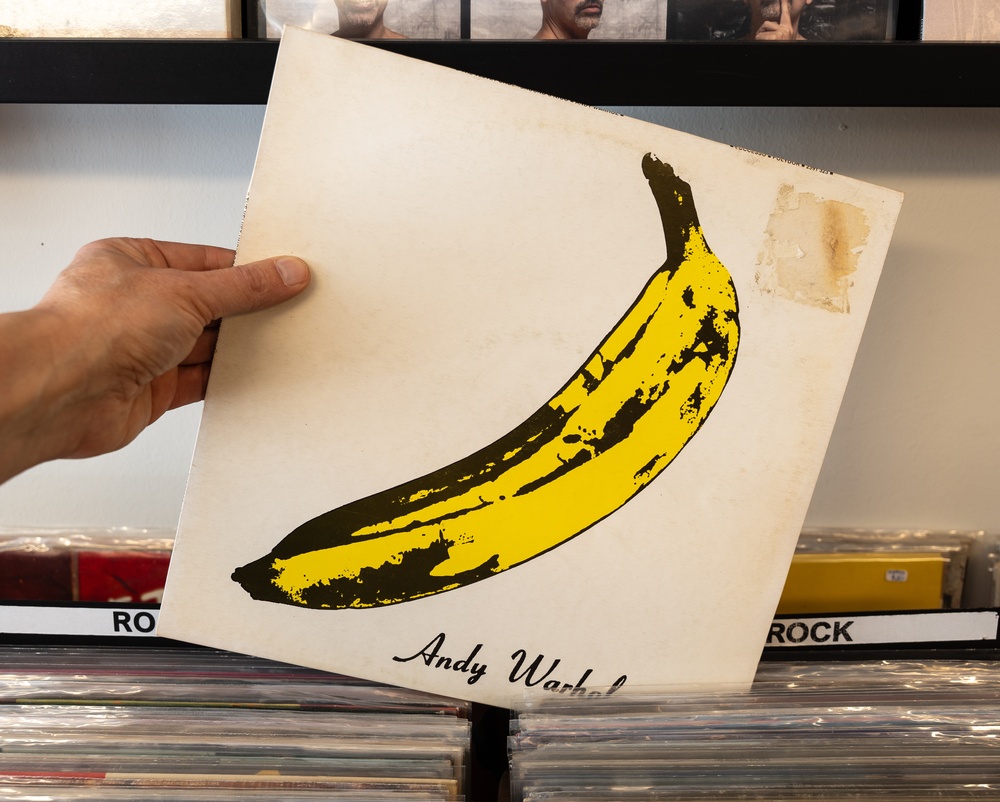
In return, he would take a quarter of their earnings. He funded new amplifiers and relocated rehearsals to the Factory. Soon their amplifiers and guitars were stacked there like luggage at a strange airport, and the Velvet Underground became part of the scene.
In Lou Reed: The King of New York, Will Hermes portrays this moment as a creative crossroads. The Velvet Underground were no longer just a band playing clubs; they were part of a larger artistic experiment that blurred the boundaries between rock concert, gallery exhibition, and avant-garde theater. The Velvet Underground were musically adventurous but abrasive and difficult to market. Warhol was looking for a way to make them more visually striking and commercially accessible. He wanted a ‘star’ presence to front the band and he found that in Nico.
Warhol met the German model in a Paris nightclub during a European trip, and she struck him instantly as camera-ready. She looked as if she had wandered out of a European art film. Warhol already knew about her. He had archived her, clipping and saving her London Fog advertisement like a collector preserving a rare print. He had clipped another photo of her from a magazine after seeing her in La Dolce Vita. Morrissey was also entranced when he met her.
Besides being a model, Nico was also a glamorous singer. She was partially deaf and often drifted out of tune. Soon Warhol proposed pairing her with the Velvet Underground. He understood that Nico’s presence would transform the band from a downtown noise experiment into something more appealing.
When Nico flew to New York, Warhol had dinner with her in an Italian restaurant where she sat dipping her fingers into a pitcher of sangría, fishing out wine-soaked orange slices. She wore a stark pantsuit, spoke sparingly, and carried herself with a kind of Nordic severity. As described in the biography of Nico, she had spent her life drifting from one scene to another, moving easily among rock bands and artists. She moved through worlds without fully belonging to any of them. During the dinner, she spoke about Dylan writing songs for her, about her modeling and television appearances. By the end of the meal, Warhol had already begun to imagine her as part of his expanding art project.
When Nico arrived at the Factory for her screen test, Warhol guided her toward a makeshift set where a chair, a plywood backdrop, and a camera were already waiting. The first screen test captured her as an almost glacial figure, nearly motionless, her expression unreadable. In the next, she loosened slightly, flipping her hair and peering through a rolled magazine with a flicker of playfulness.
Warhol wanted to produce a multimedia spectacle that brought together music, film, and performance into a single immersive experience. The place he found to hold the event was called the Dom. Transformed from a Polish National Home into a nightclub by Warhol and Morrissey, the venue became the epicenter of the Exploding Plastic Inevitable, a rock and roll spectacle that turned performance into a total environment with strobe lights and projected films. Morrisey got to work transforming the space into a club. Walls were whitewashed to serve as projection surfaces. Film projectors whirred in overlapping loops, slide projections fractured the walls, and a disco ball scattered the light.
On the first night many people came to the club. Some wore metallic miniskirts and ostrich feathers, others arrived in office suits or college sweaters. The Dom drew an eclectic crowd, pulling in everyone from Allen Ginsberg to Salvador Dalí. Here, the audience was as much a part of the spectacle as the performers. To enter the Dom was, as one observer put it, to step into a ‘magical cave. The feeling was immersive. Carousel projectors spun abstract images from the balcony, and films flickered continuously.
The Velvet Underground was the main act. When they took the stage, they did so in near darkness, tuning their instruments as images shifted behind them. They dressed in black and wore their signature dark glasses. As they played, images of locked mouths from Warhol’s Kiss flickered overhead. Naked bodies writhed onscreen. Warhol filled the room with projectors and slide carousels, splashing overlapping images across the walls and onto the band itself. Films played on top of other films while colored lights and mirrored balls scattered reflections across the crowd.
The Velvet Underground, dwarfed by projected images and engulfed in noise, appeared almost insect-like. They played alien music at punishing volume. Behind them, images flickered: torture, abstraction, fragments of other films. Edie danced nearby, her red skirt flashing under the lights.
In the midst of this chaos, Nico remained almost eerily still. She was a model, so she knew where to stand, how to pose, and how to be seen. The staging made clear who the audience was meant to watch. Dressed in a stark white pantsuit, she stood in contrast to the band’s uniform black. Warhol understood her as a living sculpture who could anchor the chaos around her. Her presence lent the band a decadent European glamour that contrasted sharply with Reed’s streetwise New York cynicism.
The Velvet Underground played another set. Audience members described being mesmerized by the droning sound, the relentless rhythm. Reed performed a song he had written about bondage. Venus in Furs, inspired by the nineteenth-century novel about sadomasochism, created a hypnotic mood. The song’s droning viola and heavy rhythm created an atmosphere so immersive that some listeners described feeling almost erased by the music.
The Mole People, wearing garbage bags, loitered in the shadows of the club. They were creatures of the city after dark, emerging only when the ordinary world went to sleep. Inside the Dom, everything was immediate and heightened. The moles liked it that way. They inhabited the club as if ordinary existence were intolerably dull.
As one Mole Person put it, anything was preferable to ‘the unbearable emptiness that the outside held.’
Nico sang as Malanga cracked a whip. Her voice was a low, spectral hum. Her own image, projected behind her, created a doubled presence. It was a moment that embodied Warhol’s fascination with repetition and reflection, the blurring of original and copy. Edie’s image flickered against the walls as she moved around the club with a jittery grace. Malanga snapped his whip while Nico played tambourine. The crack of leather became percussion, syncing with Nico’s tambourine.
During the set, Lou Reed bristled at the attention Nico received. He saw her as a model posing as a musician. Reed played guitar with a style that was raw and hypnotic. He performed Femme Fatale, a song he had written about Edie’s irresistible but destructive allure. Edie, who doubted the musicians’ technical polish, ‘sensed the intelligence behind the noise.’ She wanted a part in the new rock-band project. She didn’t want to be a decoration in someone else’s spectacle.
‘What’s my place with the Velvets?’ she asked.
She didn’t really have a place. With his music project underway, Warhol’s attention shifted. Edie, once the undisputed star of the Factory, found herself displaced. She no longer generated the same excitement she once had. Nico became the latest surface onto which Warhol projected his evolving vision of celebrity.
Warhol still wanted Edie in his cinema. He cast her in Lupe, shot one December day in a borrowed apartment at the Dakota, the Gothic-style apartment building overlooking Central Park.
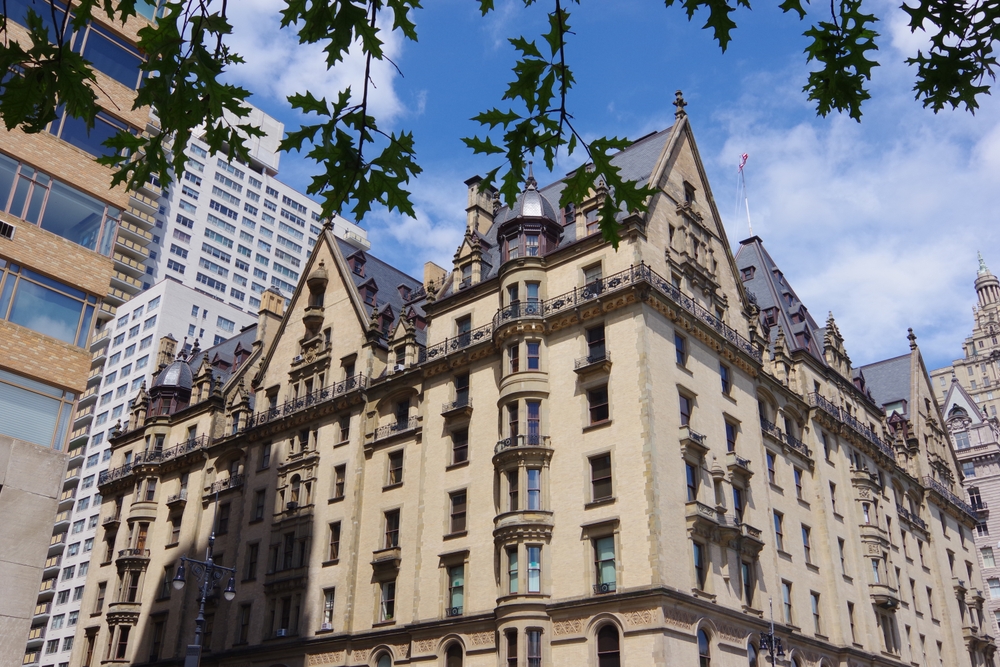
The film was inspired by Hollywood Babylon and its lurid account of the death of Mexican film star Lupe Vélez. Like Vélez, Edie became famous for playing herself, her identity inseparable from the image she projected. The film was a thinly veiled portrait of Edie, though she may not have fully realized it. Warhol used a sync-sound Auricon camera, which produced a notably low-quality soundtrack. The set he used was saturated with mirrors, from the bedroom wall to the bathroom door.
Lupe begins with a long, languorous take of Edie asleep, swaddled in mauve silk. When she wakes, she lights a cigarette, chews some gum, and studies her reflection. For half an hour she applies makeup. Dressed as the doomed movie star, she drifts through the space with a kind of exhausted elegance, lighting cigarette after cigarette, her boredom tinged with despair. Edie does very little, yet everything feels charged. As the film progresses, the mood darkens. She enters a richly furnished dining room in a pale-blue nightgown, placing flowers on the mantel. She drinks, smokes, takes pills, and dances with a wineglass in her hand.
When left alone, Edie is unable to tolerate the silence, filling it instead with drugs and fleeting distractions. She takes some more pills and slumps by the toilet from an overdose of barbiturates. It is an image lifted from Anger’s sensationalized account of Vélez’s death. The scene ends with a jarring cut to her lifeless body, now shown from multiple angles. A full-length mirror on the bathroom door doubles her body, reinforcing the film’s obsession with replication and distortion.
The film stands as one of the most haunting artifacts of their collaboration. By placing Edie in a setting of wealth and then destroying her, Warhol dramatized both his aspiration and his fear of loss. Warhol was criticized for doing this. When accused of making ‘inhuman’ films, he replied that they were simply ‘very real’—that nothing was hidden. Everything, he insisted, was left in. The camera made no attempt to comfort the viewer. It offered no protection, only proximity.
Edie was becoming more unstable. After setting her apartment ablaze with lit candles, she drifted to the Chelsea Hotel. The hotel was populated by writers, musicians, and drifters.
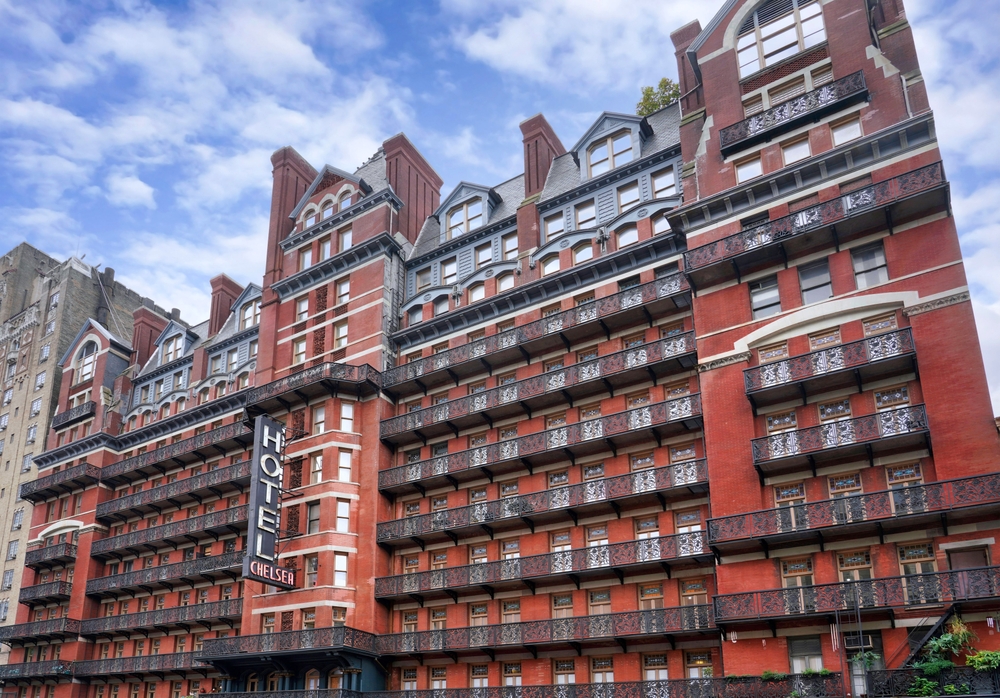
The lobby, at any hour, resembled a casting call for a film no one had yet written. Guests, no matter how damaged or dislocated by the outside world, could become whatever they imagined at the hotel. There was a promise to remake yourself. Yet beneath that promise lay a more troubling truth—that the freedom to become anything also meant the freedom to unravel completely.
As recounted in Inside the Dream Palace by Sherill Tippins, the Chelsea was a dormitory for Factory laborers. Ten dollars a week could get you a room next to a superstar. Edie lived there among truck drivers and elderly pensioners in fur coats. The hotel was run down. Hallways carried the scent of incense and smoke, the pipes rattled and the floorboards creaked. Beautiful misfits and self-appointed visionaries wandered the dim corridors, including a trench-coated preacher and a solitary woman who spoke only to God. Burlesque dancers like Patti Cakes and Cherry Vanilla drifted through the lobby. A circus fat lady sometimes found herself stalled in the narrow lift.
Behind each door lay a private drama, glimpsed only in fragments. In a dimly lit room, a musician sat awake, scribbling lyrics. A playwright wearing rumpled clothes drifted between rooms trailing cigarette smoke. Down the hall, a teenage poet stumbled to the door wrapped in a bedsheet. From the next room came the steady clatter of a typewriter. A West Indian maid with hair dyed red was seen talking to a midget called Mr. Normal. Allen Ginsberg wandered naked through the rooms, chanting mantras. Warhol stood nearby taking Polaroids while people ran naked through the hall.
The Chelsea Hotel offered both sanctuary and stage for Edie. She knew everyone and moved through its corridors like a resident star. She wandered the dim hallways, where she made friends with International Velvet, another superstar. International Velvet was in awe of Edie and wanted to become a personality like her. She studied her walk, her hair, her clothes. She watched as Edie applied her makeup each day, transforming her face into a carefully constructed mask. Under Warhol’s guidance, she reshaped herself in Edie’s image.
Bob Dylan, newly returned from a difficult tour, took refuge in the hotel to write songs for his next album Highway 61 Revisted. To Dylan, steeped in the traditions of American folk and literature, the Chelsea felt like a living archive. It hummed with the residue of realist novelists and Depression-era poets. You could fall asleep there and wake up disoriented, unsure of the era. The hotel conjured a strange, distorted past: a nineteenth-century America filled with ecstatic visions and mystical experiments. The residents often seemed like relics of an alternate timeline.
While at the hotel Dylan became close with Edie. He seemed to recognize something in her that others missed. He admired her strength as she was one of the few people who could stand up to his enigmatic personality. He soon visited the Factory with her and sat for two screen tests. As Edie spent more time at the Chelsea with Dylan, the shift did not go unnoticed. Warhol found himself on the outside, reduced to calling rooms from the lobby in search of his missing star. He sensed the drift and hurried to cast Edie again to get more footage of her.
Leonard Cohen arrived there as a suited poet with a briefcase. He settled into a room with the quiet ambition of becoming a songwriter. When he met Nico he was stunned by her beauty. To win her over, he began experimenting with love spells using candles bought from a nearby Caribbean botánica. The spells didn’t work and he just ended up being her friend, hanging out and writing songs for her.
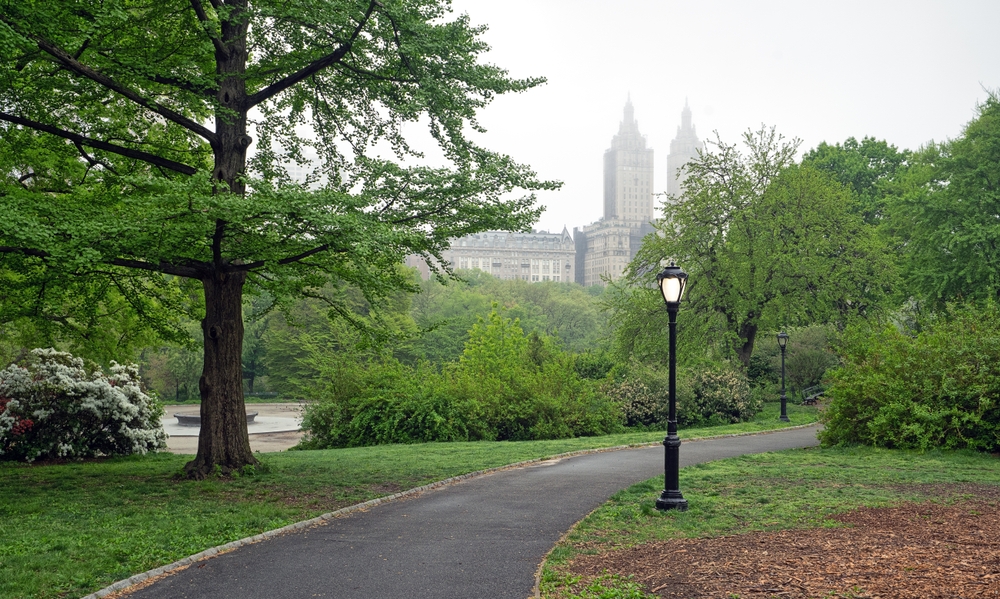
Ondine, meanwhile, was homeless and sleeping in Central Park. The vast urban park with its green meadows, lakes, and wooded paths was his refuge.
So Edie hired him to become her French maid for thirty dollars a week, a job that mostly involved waking her up in the morning and supplying amphetamines so she could function. Edie woke as sunlight filtered through heavy curtains. Her room was in disarray, scattered and untidy. Clothes were strewn across the floor. Ondine would knock on the door until she finally answered, groggy from barbiturates. She could barely get up, only reviving after coffee and amphetamines. Edie needed to be managed—woken up, dressed, and delivered to the set.
She lived in a kind of magnificent disarray, reclining on her bed in black lingerie, her kohl-rimmed eyes alert and amused. Her apartment, cluttered with wigs, coats, and curious objects, felt like a stage set for a life perpetually in rehearsal. When Ondine came over, they listened to opera together. Then the music shifted from opera to The Beatles.
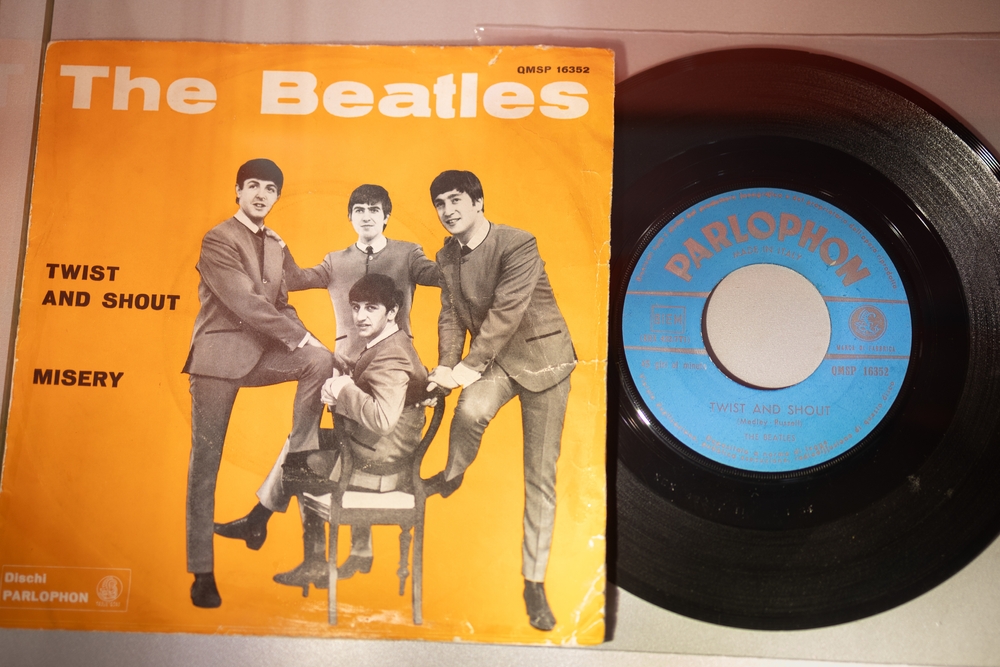
They read the I Ching and interpreted its cryptic messages. Edie owned a huge leather rhinoceros footstool and they would sit on it discussing art and philosophy. When he left, she did modern dance exercises on a small Japanese carpet
Leonard Cohen drifted down the corridor of the Chelsea Hotel like a visiting mystic. Attuned to omens and symbols, he was unsettled being in Edie’s room, where candles crowded the mantel. He saw that her candles were arranged in a way that suggested ‘fire and destruction.’ He muttered about bad spells and the threat of a fire, but she laughed him off. A few days later, her room combusted into flames. Trapped by smoke and a jammed door, Edie burned her hands on a scalding knob to escape, collapsing into the hallway as her cat died in the blaze.
Cohen talked with Dylan about the ominous events of the fire. The conversation drifted from music to magic, from poetry to alchemy. Cohen was attuned to the spectral undercurrents around him. People spoke of ghosts in the hotel since it was such an eerie place. The residents often appeared as if they had stepped out of another era.
Warhol continued producing films at a steady pace. In his work he transmuted Edie’s beauty and breakdowns. His focus was not on her well-being but on her image, on what would appear on celluloid. She would arrive for a shoot looking exhausted, but as soon as the film began to roll, she transformed. The camera caught her in states of collapse and composure. Edie was vulnerable and needed someone to be her friend, but Warhol preferred to be a witness. What unfolded between them was less a friendship than a performance, where her life became material for his camera. She felt unmoored and disoriented, unsure of her place or direction. Edie, for all her photogenic certainty, could hardly figure herself out.
Meanwhile, the studio was churning out new superstars in her image. Warhol needed new faces, new energies. Stardom was no longer earned or even constructed; it was assigned. The Factory was a machine that produced and discarded superstars with unsettling efficiency.
Over dinner at the Ginger Man, Edie confronted Warhol about money. She was broke. She had starred in his films for nearly a year and received little more than notoriety.
‘I’m not making any money on the movies,’ he replied. ‘You gotta be patient.’
Edie got her next lead role in the film Ciao! Manhattan. Friends warned her not to do it, sensing that the project was just going to exploit her. But she wanted to make the film. The promise of relevance, of being seen again, was too powerful to resist.
The film was a glimpse into the life of a fallen star. Edie, visibly fragile and chemically exhausted, drifted through an empty swimming pool, talking in a soft, damaged murmur about the life she once lived. Her voice, often drawn from real taped interviews used in the soundtrack, spoke of betrayal, exhaustion, and the emptiness of being briefly worshipped by a culture that had already moved on to its next icon. In the interview clips, Edie spoke candidly about fame, drugs, and family pressure. The clips had the unsettling intimacy of an overheard therapy session.
Ciao! Manhattan offered a vivid snapshot of the city’s artistic and social landscape at the end of the 1960s. One of the first scenes was filmed at a Be-In in Central Park.

Edie wandered among the crowd as the camera followed her. Young women in bell-bottoms and Afghan coats reclined against the grass of Sheep Meadow. East Village dropouts, wearing military-surplus jackets, mingled with Bronx poets in wire-rimmed glasses. Edie wandered off and vanished into the crowd. She could not be directed, only followed. Allen Ginsberg, reciting mantras, found himself cast as a kind of spiritual guide, though even he wasn’t entirely sure what the film was trying to say. The cast was confused. Nobody seemed to know what they were making. The instructions were vague: abandon yourself, surrender to the moment, forget the boundaries that usually hold a person together.
Edie’s co-star in the film was Paul America, a handsome drifter from New Jersey. During his screen test, Warhol said he looked ‘like a comic-strip drawing of Mr. America,’ so he renamed him Paul America. His physical perfection fit into Warhol’s obsession with surfaces, celebrity, and manufactured icons. America functioned as a kind of beautiful void. He was famous for being looked at.
It was not just America’s beauty, but his vacancy that transfixed the Factory crowd. He was, in Ondine’s view, beautiful, sweet, and incredibly dumb. America’s emptiness functioned as charisma. The word ‘America,’ he said, followed him everywhere. Hotel signs, newspapers, television broadcasts: the country appeared to be addressing him personally. He developed paranoia around the word and came to believe that the nation’s problems somehow reflected his own.
America became part of the unstable emotional landscape of Ciao! Manhattan. During one shoot, he simply drove away from the scene, abandoning the production mid-moment and disappearing for months. When he resurfaced, it was in a jail cell in Michigan. The filmmakers visited him there to complete his scenes in the cell.
Back in New York, the filming was unfocused and chaotic. Participants drifted in and out, often too wasted to function or too distracted to produce anything coherent. Days blurred together in a haze of substances and half-formed ideas. Characters lounged in cavernous apartments and rooftop spaces. At one point, an entire studio was filled with sand to create a beach scene, burying furniture. An office was ruined and antiques were damaged in the shoot. Edie stumbled through scenes that felt increasingly hollow. She was really wasted. Faces flickered in and out of recognition. She wandered through scenes half-dressed, her speech slurred. Even in moments where she appeared distracted or chemically dulled, the camera remained magnetized by her face.
There were long shooting days and the directing had a haphazard quality, as though scenes were discovered rather than carefully constructed. Scenes began without explanation and ended without resolution. In one shot, Edie appeared at dawn, walking along a brick wall near the Fort Lee castle, performing an imaginary high-wire act. The filmmakers wanted more of her but she drifted away. Between takes, she escaped into hidden corners of the castle.
The castle’s masonry was pale and weather-softened, catching the Hudson light in uneven tones. Nearby, Allen Ginsberg sat naked among a group of young people, chanting mantras across the river. Elsewhere, naked figures wandered through wooded landscapes, gazing across the Hudson at the glittering expanse of Manhattan.
Later, in a poolside orgy scene at the Ansonia, the camera recorded scenes that would never be publicly screened. The superstars stood naked by the side of the pool. They jumped into the water and climbed onto a floating raft where they were encouraged to make out with each other. Edie wasn’t keen to do it so she slipped from the raft and swam some laps, her body cutting clean lines through the water. She then dove deeper. She surfaced briefly, her face catching the light, before disappearing again beneath the water.
Edie recalled filming at the pool that evening. Her voice carried the same hazy disorientation that seemed to define the night.
‘I was already so bombed I don’t know how I got there,’ she said. ‘The whole place turned into a giant orgy…every kind of sex freak, from homosexuals to nymphomaniacs.’
In the film, grainy black-and-white footage collided with saturated color. There was psychedelic imagery with starbursts, fragmented overlays, and shifting color palettes. The grainy footage and fragmented editing intensified the sense of psychic disintegration. The film stripped away its own illusions. What remained were hangovers, bad lighting, and beautiful people too exhausted to continue pretending they were free.
In Warhol’s cinematic universe, the Chelsea wasn’t just a hotel; it was the dormitory of a new artistic tribe, a natural extension of his silver-lined studio. Warhol shot his film Chelsea Girls there. The Factory regulars spilled into the corridors as the hotel became a kind of living film set. The rooms became stages and the routines became scenes in the film.
The performers settled into a rhythm that was self-absorbed and strangely communal. They talked, they posed, they drifted. Some, like Nico, barely spoke at all. She just wandered through her kitchen with languid indifference.
Tippins wrote: ‘The strung-out superstars reached deep down to produce something that Warhol might find pleasing: a lesbian torture fantasy, an intimate confession, or just quiet weeping while trimming one’s bangs on a hot, lonely afternoon.’
The camera lingered on people who were not exactly acting. These were not rehearsed performances but volatile improvisations fueled by ego, drugs, and a relentless need to be seen. Arguments erupted in the lobby in the early morning hours. Everyone seemed both lonely and overexposed. Every gesture anticipated an audience. A young man boasted weakly about how adored he was. A woman speaking too loudly in a cluttered room suddenly appeared terrified of silence. The film exposed the emotional desperation hidden beneath the Factory’s cultivated coolness.
Brigid Berlin confessed to the camera with the frankness of somebody who no longer distinguishes between privacy and performance. Ondine launched into a torrent of speech that was by turns absurd, confrontational, and darkly comic. Warhol shot Brigid Berlin dealing drugs from her suite and filmed Nico quietly making tea in her kitchen. Berlin, in one scene, played a frantic drug dealer so convincingly over the phone that a switchboard operator, listening in, alerted the police. When the narcotics squad arrived, it wasn’t entirely clear what was staged and what was real.
The film often felt like surveillance footage from an alternate dimension, with long takes, static cameras, people talking endlessly or doing almost nothing. In one scene Ondine engaged in what looked like a riveting conversation with Ingrid Superstar. Nico mumbled banalities while she puttered around her kitchen. The film documented a culture that idealized emptiness. Warhol recognized that audiences would become fascinated by people simply existing on camera.
Instead of presenting a single narrative screen, Chelsea Girls projects two reels simultaneously. The audience’s attention is forced to split. Warhol creates a cinematic version of divided focus—multiple streams of information competing for attention. Focus slips in and out. You are constantly choosing where to look, what to hear, what to ignore. Watching the film becomes an act of editing in real time.
Chelsea Girls is a form of distracted viewing with competing soundtracks that dissolve into noise. Sometimes the sound comes from one screen. Sometimes the other. Occasionally both play at once, producing a blur of voices. The soundtrack offers little guidance, just ambient noise, the hum of machinery, and the occasional murmur. When the soundtrack drops out on one side of the screen, the image takes on a ghostly quality. The right side of the split screen drifts into irrelevance as a new figure enters on the left—a woman, slightly out of sync with the rhythm of the scene. From the start, something feels off.
Ondine circles the room. When the woman insults him, his response is playful at first. But when she repeats it, something shifts. He throws a glass of Coke in her face, then slaps her. He slaps her again. The woman, confronted with real aggression, momentarily forgets the camera. ‘Stop it,’ she shouts. ‘Don’t touch me.’ The right screen might as well disappear. All attention is drawn to the spectacle of violence unfolding before us. Ondine’s rage remains tethered to the camera. Even as he spirals into hysteria, he circles back, reasserting his awareness of being seen. His outburst becomes another performance.
In the film scenes of brutality and performance blend into one another. Conversations escalate into confrontations. There is an unsparing focus on cruelty and humiliation as the line between theatrical violence in the film and real-world cruelty sometimes blurs. Warhol’s films had always tested the patience of audiences, but Chelsea Girls pushed the experiment into new territory. Audiences left halfway through, offended by boredom, filth, and the violence of sadists and masochists on speed. It was banned in Boston, which delighted Warhol. Critics called the film a portrait of ‘America’s total degeneration.’
Warhol and Edie now had an uneasy relationship. Theirs was less a friendship than a performance staged for the camera. They appeared together at a horse race, still paired in the public imagination. Even as rumors of a split circulated, she and Warhol continued to appear together in public, photographed at parties and written up as though nothing had changed. In November, they were still being described as ‘the most contemporary couple around.’
Warhol turned his camera back to Ondine, extending his ongoing fascination with Factory regulars. The shift became the basis for a new film project.
Gopnik wrote: ‘The Loves of Ondine tracked the Factory’s favorite gay speed freak as he tried to get it on with various women.’
Ondine was trying to go straight. He delivered lines that were both hilarious and brutal, embodying the Factory’s blend of wit and cruelty. At the time he was described as ‘the underground’s greatest dramatic actor.’ In the film, his character sets out to ‘re-adjust’ his sexuality through a series of romantic encounters with women. Each encounter feels like a screen test for a life he may or may not want. The film treats these meetings like drifting conversations at a late-night party.
Just as Ondine’s mission begins to feel almost plausible, the film wanders off into a surreal interlude: a group of Latino men calling themselves the Banana Cuban Boys get into a food fight, while Ondine looks on. The highlight of the film is a wrestling match between Ondine and a languid Joe Dallesandro, shot in his Greenwich Village apartment. The scene is a re-enactment of the legendary bout between Gorgeous George and Dandy Dan Miller at Madison Square Garden. It is an homage to the theatrical brutality of professional wrestling.
Warhol had a detached directing style while making the film. He often sat in a corner, reading a newspaper while the camera rolled, occasionally flicking it on and off without even looking through the lens. Many of the scenes were unwatchable. The final cut was assembled from reels intended for multiple films. Part of what made The Loves of Ondine so disorienting was its patchwork construction. Scenes appeared to bleed into one another without clear transitions and characters shifted roles and relationships without explanation.
Meanwhile the Silver Factory was starting to deteriorate. The silver peeled off the walls. The pay phone had been ripped from the wall, the receiver wrapped in a bandage, and placed on a table like a wounded relic. There was a different energy from the earlier days, less naïve, more transactional, and tinged with something darker. After Chelsea Girls was released, the Factory’s ‘underground movie superstar’ became Nico, and the machinery of attention rolled on. Tall, icy, and photogenic, she seemed made for the role of Warhol superstar. Warhol began promoting her as the ‘Girl of the Year.’ She was photographed endlessly by Billy Name and Steve Schapiro, framed in silver walls and strobe lights.
Nico was cool, distant, and surrounded by admirers. Friends and collaborators described her as enigmatic, difficult, hypnotic, and emotionally remote. She embodied the seductive vacancy at the center of the 1960s avant-garde. If Warhol had initially cast her as a beautiful surface, she gradually reinvented herself as something stranger and more severe. He used her often in his films which were becoming more experimental and more invasive. Nico didn’t like it. She described Warhol’s approach as intrusive, even predatory, objecting to the way he filmed people regardless of their consent or comfort.
The Factory was an emotionally vacant place. The silver walls reflected everything and absorbed nothing. Superstars were created, consumed, and replaced with a rhythm that mirrored the culture’s accelerating appetite for novelty. But the superstars were not simply victims. They were collaborators in a radical experiment that collapsed the distance between life and art. Warhol created a living document of a particular time and place. By the late 1960s, he was no longer just an observer of chaos, he was one of its architects. What had begun as an experiment in observing American excess gradually became a system for producing it.
As a new superstar Nico was welcome in the back room at Max’s Kansas City, where painters, poets, and rock stars hung out at Warhol’s table. The cramped space had originally been a neglected overflow area, furnished with plain tables, red cloths, and wood paneling. No one wanted it—until Warhol did.
The restaurant was the unofficial clubhouse of the scene, a gathering place for aspiring superstars. If you wanted to be in a Warhol film, the back room was your audition. You showed up and made yourself interesting. Sometimes that meant removing your clothes. Sometimes that meant delivering outrageous monologues. A group of young men, known as ‘back-room nymphets,’ hovered nearby, hoping for a film role. They treated the place like a stage set. To sit at Warhol’s table, to be noticed, to become part of the ongoing performance, that was the goal.
The front room belonged to the hard-drinking Abstract Expressionists, whose large-scale, emotionally charged paintings had dominated New York art a decade earlier.
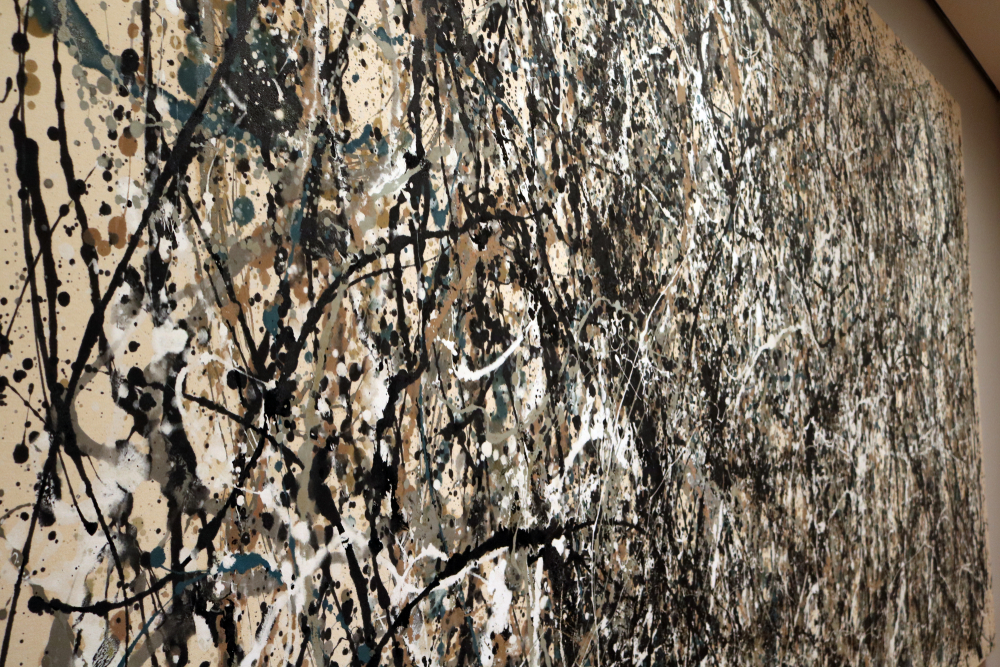
They were all heterosexual alcoholics. Artists like Frank Stella and Donald Judd argued loudly over drinks. They often got into fist fights. The windows in the front room shattered every few months during particularly heated debates among the artists. Painters sometimes paid their bar tabs with artworks. Over time, Max’s walls filled with pieces by Frank Stella and Dan Flavin. A red fluorescent light installation by Dan Flavin illuminated the back room.
Meanwhile, Edie was in a bad way. Friends described her as desperate, caged, her energy taking on a frantic edge. When she talked she was prone to drifting away mid-conversation. Getting up in the morning, she moved languidly around her kitchen. Coffee, cigarettes, and amphetamines replaced breakfast. She slouched across the bed in smeared mascara and oversized sunglasses. Her appearance was changing. She looked thin and pale.
Warhol’s superstars, so luminous within his orbit, often dimmed once they stepped outside it. No one embodied this more than Edie. She chased experience with a kind of urgency that suggested time was running out. The parties now felt frantic rather than joyous. They only heightened a growing sense of uncertainty and emptiness. She was no longer making films with Warhol. Without the gaze of others to define her, she seemed to lose her bearings. As she faded in isolation, Warhol remembered the adoration she inspired.
‘One person fascinated me more than anybody I had ever known,’ he said. ‘And the fascination I experienced was probably very close to a certain kind of love.’
At first, Edie seemed to prosper at the Factory. It was only later, as the stories darkened, that the cost became undeniable. Warhol was often portrayed as a manipulative figure who exerted a powerful, unsettling influence over those around him. His talent for anointing superstars left behind emotional wreckage. The Factory became a roll call of beautiful casualties, the silvered rooms turning private damage into public spectacle. Edie was both a participant and a victim there. Around her, the Factory’s films became less like cinema than documents of her mood and personality. There were nights of ecstatic creativity followed by mornings of collapse. Yet nowhere in the films were there consequences for the drugs that fueled them.
Warhol’s shyness and fear of touch translated into a practice of cool observation. It was as though he was archiving a world he refused to fully inhabit. Factory regulars spoke about the emotional cost of his detached fascination and how he lived ‘vicariously through their insanity.’ In this way he was able to benefit from intensity without absorbing its consequences.
Edie was going through a difficult time. Friends described her apartment as dark and grim, with clothes and cosmetics scattered in disarray. They recalled visits where all she talked about was how high she was or how high she had been. Amphetamines hollowed her out. She was barely present, her attention slipping away from the immediate world. She was bargaining for pills, manipulating doctors, and drinking vodka to intensify the sedation. She had a habit of falling asleep with a lit cigarette after taking barbiturates, so her bed was always catching on fire.
Edie wandered through her apartment dazed and spectral. She rarely lived by daylight, sleeping through much of the day and staying awake through the night. The curtains stayed drawn. Meanwhile cigarettes burned in every ashtray. She would light one, set it aside, light another, and forget the first. She searched handbags and drawers for misplaced pills. The floor was littered with magazines, clothing, and empty prescription bottles.
Edie Sedgwick died of a barbiturate overdose on November 16, 1971. She was 28 years old.